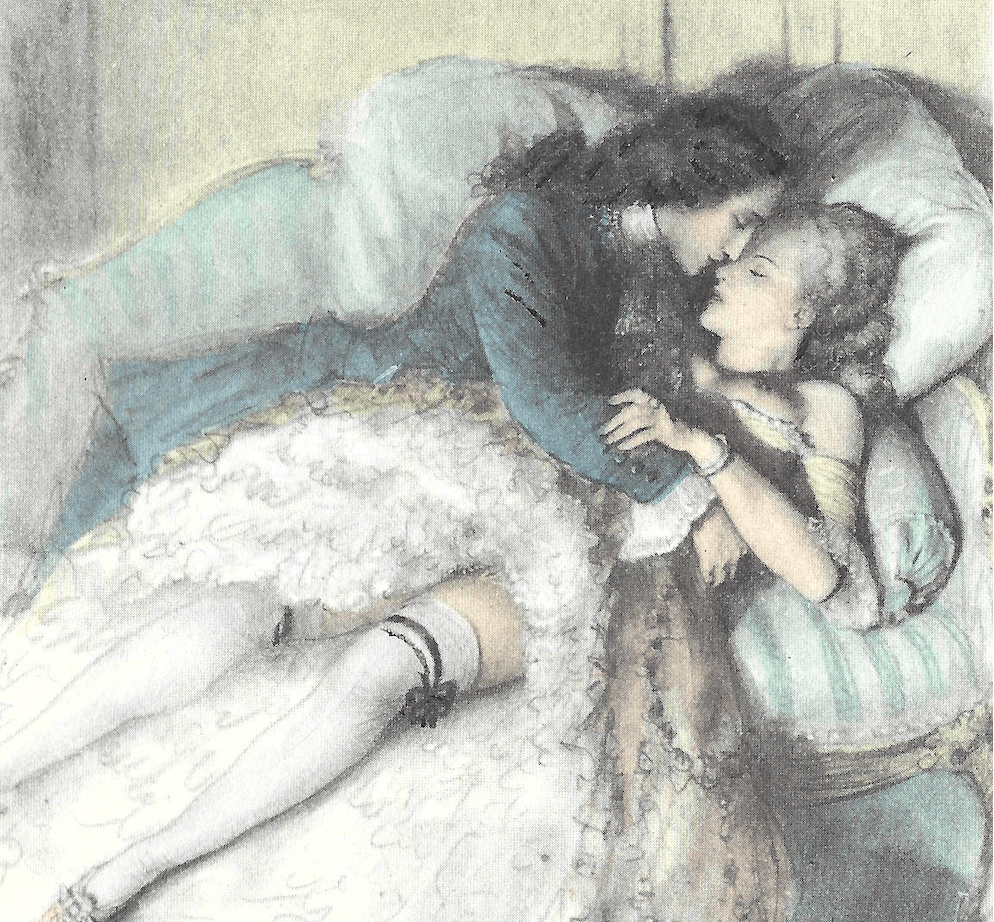
Just about every time Christopher Hampton’s play Les Liaisons Dangereuses has been produced in the last ten years or so, many of the reactions have stumbled on the scene in which Valmont takes sexual advantage of Cécile de Volanges, a girl who (1) is explicitly identified as a 15-year-old virgin in the text of the play as in the text of the novel; (2) repeatedly says no and (3) is distraught afterward. Are we witnessing a rape onstage? If the answer is yes, various complications follow: (1)Tthe play’s leading female character, the marquise de Merteuil, mocks Cécile’s distress and tells her to get with the program; (2) Cécile quickly becomes Valmont’s enthusiastic “student,” sometimes depicted as far more enthusiastic than the blasé vicomte; and (3) by the end of the play, we’re meant to see Valmont as at least somewhat redeemable and sympathetic. When the play was produced at the Stratford festival in Canada last year, one reviewer even suggested the play was too “toxic” to be produced today. (Another review praised the production for exploring sexual violence, while still another criticized it for not making #MeToo issues more prominent.) While the new production has tried to address these issues with a rewrite that makes Cécile slightly older and (apparently) more consenting, those issues have still come up in some reviews. (The Valmont/Merteuil duo also inevitably suggests parallels to a real-life, modern-day pair of very rich and sexually depraved people: Jeffrey Epstein and Ghislaine Maxwell.)
But the question of rape and consent in Les Liaisons Dangereuses has also showed up, with increasing frequency, in scholarly writing about Laclos’s novel (especially with the rise of feminist scholarship). In the 2021 French documentary on the novel and its legacy, Les Liaisons Scandaleuses, Sorbonne professor emeritus Michel Delon notes that while it used to be standard to speak of “the seduction of Cécile Volanges,” today’s Liaisons discourse generally speaks of the rape of Cécile. What’s more, some recent critiques have also argued that Valmont’s first sexual experience with Madame de Tourvel should also be regarded as the rape of an unconscious woman.1
Are these readings supported by the novel, and do they enhance or impoverish our understanding of it?
Valmont and Cécile
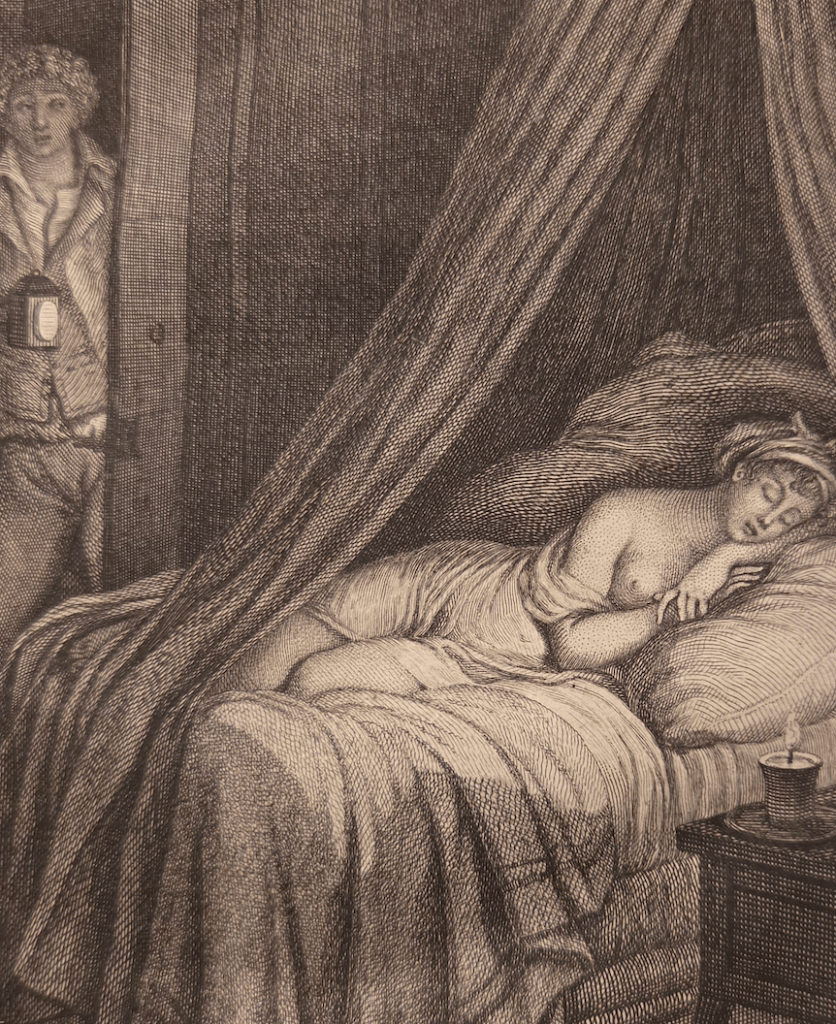
Cécile’s defloration takes place midway through the novel, which, of course, starts with Merteuil’s offer—or order—to Valmont to seduce the girl for revenge against the comte de Gercourt, who once left Merteuil for another woman and who now wants Cécile for his convent-educated virgin bride. After Valmont turns down this venture as too easy, Merteuil switches to Danceny as Plan B, with Valmont assigned the role of prodding Danceny to action and facilitating the romance—particularly after Cécile’s mother, Madame de Volanges, takes her to the château of Valmont’s aunt. Then, for motives to which we’ll return later, Valmont decides to take on the Cécile seduction after all. He pressures Cécile—with Danceny’s unwitting help—into stealing her mother’s key to her bedroom so he can get a duplicate made, supposedly to deliver Danceny’s letters more easily. In Letter 96, he gives Merteuil an account of his “first visit” to Cécile’s bedroom, when he wakes her and promptly makes his move. (All the quotations are from my recently completed new translation of Les Liaisons dangereuses.)
Clearly they hadn’t taught her well at her convent how many various perils lie in wait for timid innocence, or how much it must protect to avoid being taken by surprise; for while she gave all her attention, all her strength to defending herself from a kiss, which was a mere feint, everything else was left unguarded; how not to take advantage! I changed my tactics and immediately seized an outpost. Here we both thought we were done for: the little girl, utterly terrified, tried to cry out in earnest, but her voice dissolved in sobs. She also reached for the bell-cord, but I was adroit enough to catch her arm just in time.
“What are you trying to do?” I said. “Ruin yourself forever? Let people come—what do I care?2 Whom do you expect to persuade that I’m not here with your consent? … And this key which I got from you, and could only have gotten from you—are you going to explain what it’s for?” This short speech did not soothe her distress or anger, but it did compel submission. I don’t know whether my tone was eloquent; it is true, at least, that my gestures were not. One hand used for restraint, the other for love—what orator could hope to be graceful in such a position? Yet if you picture this scene clearly, I’m sure you will agree it was at least favorable to an offensive; but of course I know nothing, and as you say, the simplest of women, a boarding-school girl, leads me along like a child.
,,, Finding me unmoved by pleas, she moved on to bargaining. You think I exacted a high price for such a strategic post; but no, I promised everything for a kiss. True, once the kiss was taken, I didn’t keep my promise; but I had my reasons. Had we agreed whether it would be received or given? After some haggling, we settled on a second one, and this one, it was said, would be received. … [T]he sweet kiss was indeed received—and well-received, perfectly received: so perfectly, in fact, that Love itself could not have done better.
Such good faith deserved a reward, and I immediately granted her request. The hand withdrew; but, I don’t know by what accident, I myself ended up in its place. … I was quite pleased to observe, firsthand, the power of opportunity, here stripped of any external aid. Yet it was up against love—moreover, love backed by modesty or shame, and reinforced even more by the ill temper I had provoked, which was no small matter. Opportunity was on its own; but it was there, always offered, always present, and love wasn’t there.
To ensure the success of my experiment, I had the malice to use no more force than she could easily resist. Only when my charming foe, taking advantage of my complacency, seemed ready to escape did I restrain her by means of the same fear whose happy effects I had already seen. Well! With no further effort, the lovesick damsel, forgetting her vows, yielded first and ended up consenting—not that the complaints and tears didn’t come back after that first moment. Whether they were genuine or pretended, I don’t know, but as always, they stopped as soon as I gave them fresh cause to resume. So, from weakness to reproach and from reproach to weakness, we did not part until we were fully satisfied with each other and in perfect agreement on tonight’s rendezvous.
Obviously, such a letter written today would be more than sufficient evidence for a rape charge, and likely a conviction. (Even before the rape law reforms of the 1970s-1990s, it would have been grounds for a conviction on a lesser charge of sexual battery.) Just as obviously, Valmont and Cécile do not (fictionally) exist in our time; they are creatures of an 18th Century culture in which everyone—man or woman—assumes that “no” means “keep trying.” However, these norms generally apply to situations in which a woman and a man are willingly engaged in at least potential romantic interaction; that’s not the case here, since Cécile is in love with Danceny and has never expressed any interest in Valmont as a sexual partner. For what it’s worth, the debate on whether Cécile is a rape victim predates modern feminism. The 1904 book Notes sur Laclos et Les Liaisons dangereuses by critics Jacques de Boisjolin and Georges Mossé, one of the first serious critical studies of the novel, refers to “the half-consensual rape of the young Cécile Volanges” as one of Valmont’s “acts of pure depravity.” In his preface to the 1952 Garnier edition of Liaisons, noted French writer and critic Yves Le Hir voiced his disapproval of Laclos’s depiction of “a child who is raped, and who squeals with delight afterward.” On the other hand, in the magisterial 1964 tome A la recherche des Liaisons dangereuses [In Search of Les Liaisons Dangereuses], the husband-and-wife team of André and Yvette Delmas responded that Cécile is most definitely not raped and, in the novel’s social context, not a child.
It is also noteworthy, perhaps, that Paul-Émile Bécat’s illustration depicting Valmont’s “first visit” to Cécile in the 1949 Athena (Paris) edition of Les Liaisons dangereuses looks more like a sexual assault than a consensual experience.
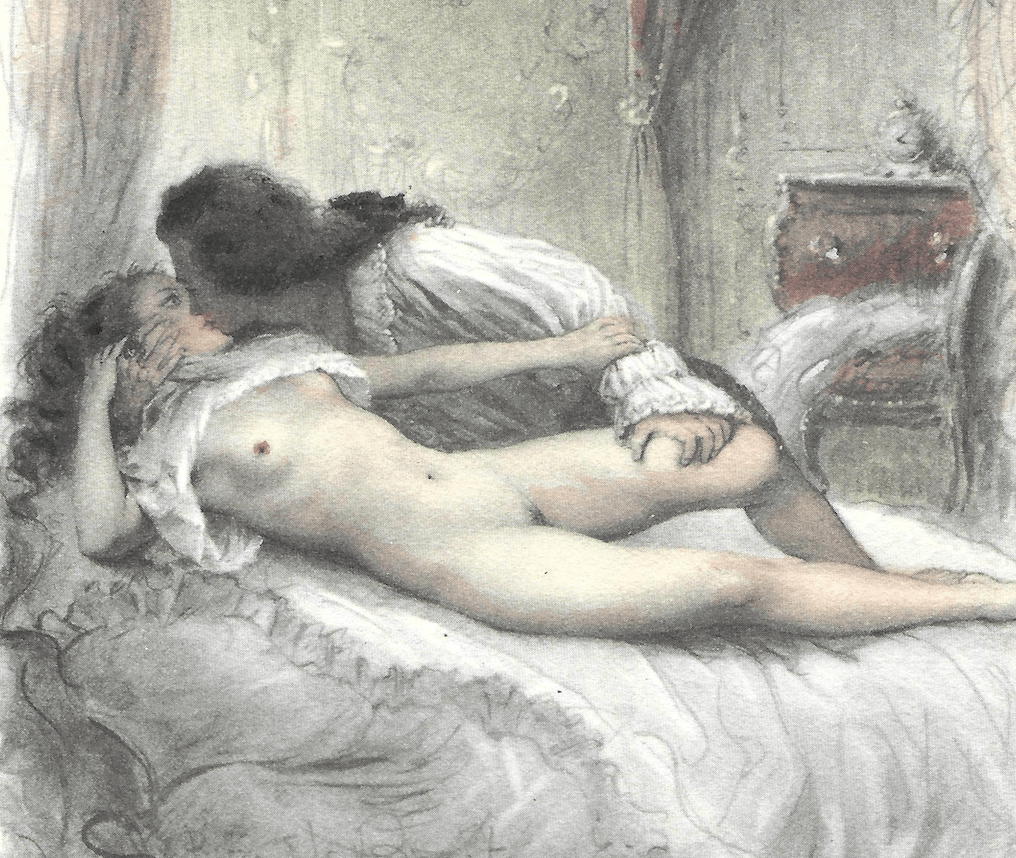
However classified, it is, even by 18th Century standards, a highly disturbing scene—made all the more so by Valmont’s flippant, witty narration. (It is far more disturbing, for example, than the passage in Crébillon’s The Night and the Moment in which, during a long night of verbal and physical erotic sparring, Clitandre uses force to obtain an unspecified “favor” from Cidalise, most likely putting her hand on his penis; Cidalise rebukes his “odious conduct” but instantly laughs it off.) But should it be regarded as a rape? What do we make of Valmont’s obviously self-serving claim that Cécile “consented” to the actual penetration?
Here is how Cécile describes the same scene in her confused letter to Merteuil (Letter 97):
A moment later, he tried to kiss me, and while I was defending myself as one naturally would, he managed such a fine trick that I wouldn’t, for all the world, have wanted … but he insisted on a kiss first. I had no choice, what else could I do? Especially since I had tried to call out, but for one thing I couldn’t, and besides he made a point of telling me that if anyone came he would be able to blame it all on me; and in fact that would have been easy, because of that key. After that, he didn’t leave either. He wanted another kiss, and that time, I don’t know what it was but it left me all flustered; and afterwards, it was worse than before. Oh! that was truly bad. Finally, after that… I hope you will excuse me from saying the rest; but I am as unhappy as one could be.
The one thing for which I especially blame myself—but even so, I have to tell you about it—is that I’m afraid I didn’t defend myself as much as I could have. I don’t know how it happened; I certainly do not love M. de Valmont, quite the contrary, but there were moments when it was as if I did love him… Of course you understand that this didn’t keep me from always telling him no, but I knew I wasn’t doing as I was saying, and that was as if in spite of myself; besides, I was so flustered! If it’s always this difficult to resist, it must take a lot of practice! It’s true that M. de Valmont has such a way with words, one doesn’t quite know how to reply. Finally, would you believe that when he left I was almost sorry, and that I had the weakness to agree that he could come back tonight?
Interestingly, Cécile’s account suggests a more consensual experience than Valmont’s, focusing on her sexual arousal (“flustered” and “it was as if I did love him” are her confused attempts to describe something she doesn’t know how to name) and Valmont’s expert verbal manipulation (which we have already seen in his correspondence with Tourvel). At the very least, it suggests more of a blurred line between coercion and consent.
This is where I disagree with Rutgers University scholar Jennifer Tamas, whose 2023 book Au NON des femmes3 contains some fascinating and insightful analysis of female agency and resistance in French classical literature. Tamas (who, it should be noted, takes a complex view of Valmont and is sympathetic to his thwarted attempt to break out of the libertine trap through his genuine love for Tourvel) believes that Valmont is quite aware that he has raped Cécile and that his amusement at her “morning-after look” is a rapist’s perverse leer at his victim. In Tamas’s view, Cécile’s account shows her disassociating from her body (“as if in spite of myself”); her failure to protest Valmont’s repeated initiations of sex is simply the “mutism” of the terrified rape victim; and her sexual pleasure should be seen as akin to the sexual sensations experienced by child victims of incest.
On the first point: It seems quite clear from the text that Valmont does not think he raped Cécile. He stresses that he is careful “to use no more force than she could easily resist”; his “experiment” is to see whether, offered a sexual “opportunity” long enough, she will eventually yield to temptation. Not only does he say that she “ended up consenting,” he also thinks that by the end of the night, she is entirely fine with it. It is also telling that his account of her “morning-after look”—awkward bearing, stiff gait, drawn face, puffy eyes etc.—omits any mention of her distress: he mentions Madame de Volanges showing a “tender concern” for her daughter but not the fact that Cécile’s response to this concern is to burst out sobbing and say that she is “very unhappy.” He is, in other words, editing his report to fit his framing of Cécile as an initially resistant but eventually willing, even enthusiastic partner. Still more telling, when she bolts her door to keep him out the next night, he is sincerely shocked and baffled, “after the friendly way we parted yesterday morning.” He even considers the possibility that Cécile was simply tired and wanted a good night’s sleep, before settling on the explanation of remorse and “something like virtue.” There is nothing to suggest that this is an elaborate joke played out for Merteuil: Valmont is genuinely and petulantly piqued about being locked out.
On the second point, there is nothing in Cécile’s account to indicate that she was struck mute by fear; rather, she explicitly says that she couldn’t think of how to reply to Valmont’s clever way with words (façons de dire). Not being entirely in control of one’s body because of sexual arousal falls far short of dissociation. As for the comparison to abused children: in the context of the novel and of the late 18th Century, Cécile is sexually mature. The plot of Liaisons starts with her mother’s plans to marry her to 36-year-old Gercourt and continues with her romance with 20-year-old Danceny. (If Valmont is a modern Epstein, then Madame de Volanges is a criminal pimping her underage daughter to a rich older man and Danceny is a would-be child molester.) Merteuil is manipulative but not entirely wrong when she points out to Cécile (Letter 105) that Valmont has taught her what she was “dying to know”; her eagerness to learn about sex is mentioned by Merteuil to Valmont in Letter 38. (“It sends her into the funniest fits of impatience … she pleads with me to teach her with a genuinely alluring guilelessness.”4)
It is also noteworthy that Cécile’s anguish is related, above all, to her infidelity to Danceny:
It especially hurt because of Danceny! Every time I thought of him, I cried harder until I was almost choking, and I kept thinking of him the whole time… and even now, you can see the result: the paper is all wet. No, I’ll never be consoled, if only on his account.
A view of Cécile as a sexual being drawn into a mostly willing (if coercive or even assaultive at the start and monstrously manipulative later) sexual relationship seems to me most consistent with Laclos’s characterization and with his central themes. It is, in a sense, a counterpoint to Madame de Rosemonde’s assertion that women can only enjoy sex with the man they love and find it repugnant otherwise—”depraved” women being the sole exception. Cécile may deceive Danceny, but she still loves him and remains more innocent and naïve than depraved.
This perspective does not make the Cécile/Valmont relationship any less disturbing, or Valmont any less repugnant with regard to Cécile. In fact, I would argue that the focus on consent or non-consent in their initial encounter unduly takes the focus off the true odiousness of what he does during their subsequent consensual (if manipulated) relationship. Partly for his cynical amusement and partly for revenge against Madame de Volanges, Valmont essentially treats Cécile as a human toy: He trains her to perform sexual services “one doesn’t always dare to demand from girls in the trade” and to talk about sex in an obscene lexicon; he plies her with made-up stories depicting her mother as a notorious slut (or rather, alters stories of real-life sex scandals to put Volanges in them); he deliberately omits pregnancy prevention—such as it was in the late 18th Century—from her “schooling” and gloats about getting her pregnant. (Later, recounting her miscarriage, he makes snide comments about her cluelessness.) Since Valmont and Merteuil intend to make sure all this blows up in a scandal that massively humiliates both Gercourt and Madame de Volanges, the likely outcome of Cécile’s sex education—as Merteuil openly states in Letter 106—is that her husband will have her locked up in a convent. 5 While Valmont’s dehumanization of Cécile is encouraged by Merteuil, who tells him that she “take[s] no more interest” in the girl because Cécile is too stupid to be a proper adventuress and can only become a “pleasure machine,” that hardly exonerates Valmont himself.
I don’t think Laclos intended to make Valmont a rapist. (He explicitly differentiates him from the rapist Lovelace of Samuel Richardson’s famous Clarissa, even though Valmont belongs to the same literary lineage of the male libertine hero.) However, he certainly did intend for him to be seen as a predator and for Cécile to be seen as a victim. Contemporary critics already referred to Valmont’s treatment of Cécile as “abuse,” and Tamas is correct when she points out that within the novel’s moral framework Valmont is a “seducer,” or seducteur—a term as fraught with moral stigma and even criminality as “abuser” or “sex offender” today.
This storyline is even darker when one considers Valmont’s motive. Here, Tamas, I believe, actually goes much too easy on the vicomte by suggesting that he is acting at Merteuil’s direction. In fact, by then Merteuil expects him merely to facilitate a Cécile/Danceny rendezvous (though she does write, in Letter 64, “If she returns from that trip as she was, I shall hold you responsible,” which obliquely suggests that if things don’t work out with Danceny he’ll have to perform the task himself).
Why does Valmont decide to “take” Cécile after all? His explanation to Merteuil (Letter 96) is that he has been less preoccupied with Tourvel once she’s started being nicer to him, and has consequently noticed that Cécile is pretty, available, and will make for a good distraction. But that’s pretty fishy, if only because he isn’t any less preoccupied with Tourvel: In the same letter, after writing, “I do not mean to speak of Madame de Tourvel,” he goes on about her for three paragraphs before catching himself.
The explanation, I think, falls into place when you look at the timing. Valmont takes his first step toward the “conquest” of Cécile—Letter 84, in which he tells Cécile that delivering Danceny’s letters is getting too difficult and dangerous and that having the key to her bedroom would make everything easier—on September 24, ten days after his arrival at the château. (Or, technically, on September 23, when he intentionally botches the delivery of Danceny’s letter.) What happens just before that? Valmont receives Merteuil’s Letter 81 (dated September 20 and presumably delivered to the château September 21), which opens with a lengthy and scathing rebuke cutting him down. Stung by the vicomte’s worries that Prévan will ruin her, Merteuil ruthlessly clobbers her partner in crime, affirming her superiority over him, mocking his “incredible clumsiness” with Madame de Tourvel (“your Présidente is leading you along like a child”) and scoffing at his report on his “sublime efforts” to bring together Danceny and Cécile. She also declares her intent to “have” Prévan and beat him as his own game, making sure he won’t be able to brag about his conquest.
It’s very likely that Valmont knows the marquise will succeed. His amour propre requires a victory to match hers—and Cécile is the obvious target. In fact, Valmont, who can never help letting Merteuil see that she is successfully pushing his buttons, more or less acknowledges this motive in his snarky aside to Merteiul alluding to her gibes in Letter 81: “But of course I know nothing, and as you say, the simplest of women, a boarding-school girl, leads me along like a child.” One may even wonder if Merteuil’s taunts are intended, in part, to produce precisely this result. (It’s likely that Valmont is still her Plan A for Cécile’s seduction, since he’s far more skilled and far less scrupulous than Danceny.) Either way, Cécile is essentially a sacrifice to Valmont’s ego—just like later on, in a very different way, Tourvel will be a sacrifice to his ego when he sends her the Merteuil-scripted lettre de rupture.
Valmont and Tourvel
A far more radical take on the novel is that Valmont’s first “possession” of Madame de Tourvel is also a rape, taking place while she is passed out—an unconsciousness induced not by drugs as in the case of Lovelace and Clarissa, but by an emotional crisis intentionally created by Valmont himself.
Let’s revisit what happens. After Tourvel flees Madame de Rosemonde’s château following an intense scene during which she nearly surrenders to Valmont—and cuts off all communication, returning Valmont’s letters unopened—Valmont comes up with a scheme to get her to receive him. He prepares the groundwork by using his aunt, who he knows is Tourvel’s new confidante, to make Tourvel believe that he is in profound despair and possibly considering suicide (Letter 122). (He also knows, by intercepting and reading Tourvel’s letters to Rosemonde, that Tourvel is desperately in love with him and that her emotional state is extremely fragile.) He then writes to Tourvel’s confessor, Father Anselme, to say that he has decided to turn to God thanks to being inspired by Tourvel’s virtue and wants to meet with Tourvel one last time to make amends and return her letters (Letter 120). The effect on Tourvel is to plunge her into intense turmoil (again, all known to Valmont via an intercepted letter). She feels hurt and humiliated, even shattered, at the thought that Valmont no longer loves her. She’s angry at God for (she thinks) giving Valmont, but not her, the strength to overcome his illicit passion; arguably, she even resents God as the presumed new object of Valmont’s affection. She is also ashamed of those feelings.
Then, Valmont shows up for their meeting (which he schedules three days after Tourvel receives the news of his supposed conversion from Father Anselme, giving her some time to stew in her pain and confusion). Quickly revealing that he isn’t “over” her—which must give Tourvel a small rush of joy and relief—he embarks on a calculated performance that drags her through an emotional roller-coaster: declarations of love and adoration, accusations of cruelty and heartlessness, expressions of guilt and despair. He also makes it clear that his intent isn’t to embrace religion; it’s to take his own life. Finally, he bids her farewell, wishing her happy and peaceful days “adorned with all the joys you’ve taken from me” and asking her to repay this wish “with a single regret, a single tear.” Here’s what happens then, as described by Valmont in Letter 125:
As I spoke, I could feel her heart pounding violently; I could see the alteration of her face; I saw, above all, that tears were choking her and yet trickled only slowly and painfully from her eyes. It was only then that I took the next step of pretending to move away; but she clutched at me forcefully to hold me back. “No, listen to me,” she said urgently. — “Let me go,” I replied. — “You will listen; I demand it!” — “I must flee from you—I must!” — “No!…” she cried out. At that final word she flung herself, or rather collapsed fainting, into my arms. Since I still wasn’t entirely sure of such a happy outcome, I affected a great fright; but all the while, even as I made a show of alarm, I was leading or carrying her to the spot I had previously selected as the field of my triumph; and in fact, she only came back to herself when already submitted and delivered to her happy conqueror.
After that, Tourvel is nearly catatonic, except for outbursts of terror (with tears, gasps, spasms and inarticulate cries) whenever Valmont tries to touch her. Finally, frantically rifling through his mental libertine playbook for stock phrases to use for a woman’s (presumably fake) distress after the first surrender, he hits upon “So you are in despair because you’ve made me happy?”—which turns out to be the key to Tourvel’s heart. She starts to calm down, and a few moments later comes her true surrender: she tells Valmont that she gives herself to him completely, with “no refusals … and no regrets,” and will devote herself entirely to his happiness.
Recent works that analyze Valmont’s “conquest” as a rape include the 2019 paper titled, “‘You had the courtesy to wait for me to say yes before you took my consent for granted’: On a Rape in Les Liaisons dangereuses” by University of Sorbonne doctoral student Melanie Slaviero and the 2024 book, The New Logic of Sexual Violence in Enlightenment France by University of Tennessse professor emerita Mary McAlpin. Both Slaviero and McAlpin state as a fact that Tourvel is in a profound faint when Valmont has sex with her (i.e., rapes her); that there is nothing to indicate that she has consented to this sexual act; and that, while a fake swoon was a well-known strategy of coy surrender at the time, it would be entirely out of character for the devout Tourvel, who, as Slaviero puts it, “seeks precisely to remove herself from this social game.”6
But the “facts” are far from certain. Yes, Tourvel is not the sort of woman who would fake a swoon as a coy game to preserve a veneer of virtue. But there’s another possibility: torn between her belief that giving herself to Valmont is the only way to save him from suicide (and eternal damnation!) and her belief that giving herself to Valmont is a mortal sin, Tourvel resolves this unbearable inner conflict with a self-induced stupor that allows her a passive surrender. McAlpin writes that Tourvel must be seen as a rape victim “unless we stretch verisimilitude by taking her last refusal to let Valmont leave—”Non!”—as a (highly ironic in its form) sign of consent before the fact.” But it’s not clear why this is such a stretch; André and Yvette Delmas, for that matter, argue that it’s precisely the signal of consent Valmont has been waiting for. Making “No!” the crucial expression of Tourvel’s consent would be a very Laclosian paradox—especially since it’s not the stereotypical fake no-meaning-yes but a sincere and passionate “No” meaning “Don’t leave.” And it must also be seen in the context of Tourvel’s anguished words to Madame de Rosemonde in Letter 108:
To be the maker of one’s own misfortune, to tear one’s heart apart with one’s own hands—and, suffering these intolerable pains, to know at every instant that one could end them with a single word—and yet this very word would be a crime!
(In general, the Slaviero/McAlpin reading of the Valmont/Tourvel scene completely ignores Tourvel’s virtually constant state of emotional anguish, even torment, between her departure from the château on October 3 and the meeting with Valmont on October 28—reaching its high, or low, point just before the meeting when she thinks Valmont has stopped loving her.)
The “criminal” word Tourvel can never allow herself to speak to Valmont is “Yes.” Within that narrative context, it absolutely makes sense that she says yes by saying “No” as in “Don’t go” (and “don’t kill yourself”).
Nor is it clear that she is actually unconscious. “Come back to herself” may refer to coming out of a daze or reverie as well as regaining consciousness; Valmont uses the same term in Letter 76 after Tourvel becomes lost in his gaze and then snaps out of it. One may also note Valmont’s curious self-corrections: from “flung herself” to “collapsed fainting,” from “leading her” to “carrying her.” Does Valmont adjust his words to a more truthful narrative, resisting his inclination to depict Tourvel as more actively consenting—or to a more chivalrous narrative that gives her a veil of passive innocence? The passage leaves plenty of room for ambiguity. (For that matter, McAlpin hedges a little, suggesting that Valmont is uncertain whether Tourvel is conscious or not and doesn’t pause to make sure because speed is of the essence.) And while Slaviero thinks that Tourvel’s near-catatonic state and her terrified reaction to Valmont’s touch afterward suggest rape trauma, that’s a “presentist” reading which cannot envision loss of virtue as traumatic. Here, McAlpin actually diagnoses the “horror” of Tourvel’s situation correctly: “What Tourvel has so suddenly lost is her self-image as a virtuous married woman.” Her “recovery” happens when she finds a new self-image and a new purpose: the woman in love who lives for her lover’s happiness. (Once Valmont’s Merteuil-scripted breakup letter shatters that self-image too, she is broken completely.)
Slaviero tries to back up her thesis with some bizarre readings or misreadings of Laclos’s text—arguing, for instance, that one of the main reasons Merteuil refuses Valmont his “agreed-upon reward” for success with Tourvel is that the success doesn’t count since Tourvel didn’t properly consent. But such scruples from Merteuil would be highly unlikely. Recall that in Letter 106, she mercilessly ridicules Valmont for not “taking” Tourvel in the scene he describes in Letter 99—when Tourvel collapsed at his feet sobbing and begging him to “save her” and “leave her,” then let him carry her to the bed while lying stiff in his arms and shaking violently. Merteuil believes that this was Tourvel’s way of surrendering; no doubt she believes the same of Tourvel’s faint or stupor in Letter 125. In any case, if Merteuil had believed that Valmont had not succeeded with Tourvel, she certainly would have told him as much.7 And she does, in fact, agree (Letter 131) to spend one night with Valmont as his “prize”; what she firmly rejects is Valmont’s proposal to renew a steady relationship.
No less oddly, Slaviero suggests that Valmont rapes Tourvel as a way to degrade her and thus prove to Merteuil that he’s not in love in her. But in fact, prior to this point, Merteuil only accused him of being in love with Tourvel once, in a letter of 12 August (Letter 10); when reporting the Tourvel “victory” two and a half months later, it is Valmont who brings up the possibility that he might be in love (only to argue against it) and discusses at some length being troubled by the “unfamiliar enchantment” he has felt. The idea that he is actively trying to degrade Tourvel here is strikingly at odds with the entirety of the letter: the epithets Valmont bestows on Tourvel (heavenly, adorable, sublime, etc.); his rapturous description of the second consummation (“The intoxication was complete and mutual; and for the first time, mine outlasted pleasure itself”); and his even more striking admission about its aftermath: “I left her arms only to fall at her feet and swear everlasting love—and, to tell the whole truth, I meant what I said.”
Slaviero suggests that her reading gives Madame de Tourvel’s character more dignity by fully crediting her earlier rejections of Valmont as genuine, not coy—a strange argument given her grudging admission that the text supports Tourvel’s love and desire for Valmont.8 But her own reading leaves us with a Tourvel who is passionately in love with her rapist, repeatedly has enthusiastic and highly enjoyable sex with him, and dies of grief when she is led to believe that he never loved her. What’s more, it runs directly counter to Tourvel’s statement to Rosemonde (Letter 128) framing her surrender to Valmont as a choice: “All I can say is that, placed by M. de Valmont between the choice of his death or his happiness, I chose the latter.”9
That’s also the reading embraced by McAlpin, who explicitly asks: “Why does she continue to love this man who has just, even by [libertine] standards, raped her?” Actually, McAlpin herself answers—or rather, preempts—the question on the preceding page, where she writes, “Tourvel does not believe herself to have been raped, nor does Valmont believe that he has raped her.” Yet, undeterred by her own explanation, McAlpin forges ahead, posing the question twice and finding the answer in Laclos’s view of the character and the relationship. McAlpin correctly observes that for Laclos, Tourvel is the “natural woman” whose candor, so radically different from the artifice and pretense that reign in 18th Century upper-class society, attracts Valmont and awakens his heart. (She links this perspective to Laclos’s writings on women and education, unpublished until a century after his death, in which he offers his vision of the free, unsubjugated woman in the primordial state of nature.10) But McAlpin also finds in this answer a very dark message—and, in the eyes of a modern reader, a damning one for the author. According to Laclos, she concludes, a “natural woman” like Tourvel must love a man (even her rapist!) who genuinely loves and desires her:
If Tourvel falls in love with Valmont—if she accepts that when he rapes her, that act is no obstacle to continuing to love him and to have sex with him—it is because he feels a ‘natural,’ non-libertine-inspired desire for her. His ability to do so is perhaps to be understood as just as unusual as her potential to uninhibitedly, unconsciously, enjoy the act of sex. Valmont’s profound, instinctual response to her extraordinary appeal as a uniquely “natural” woman in a profoundly corrupt society could only be answered by her with a “yes”—even if that conscious affirmation has to be, in order for Tourvel to remain “virtuous,” preceded by a rape.
Partly, this passage accurately reflect Laclosian themes: Tourvel’s “naturalness” as an outsider to a corrupt and artificial society brings out something in Valmont that has long been buried under the libertine persona—just as her love for Valmont brings out her sensual and emotional self buried under the persona of the “prude” whose existence is centered on duty. This theme is explored by the Swiss scholar Anne-Marie Jaton in her fine 1983 book Le Corps de la liberté: Lecture de Laclos [The Body of Liberty: Reading Laclos]: Valmont and Tourvel’s “complete and mutual” ecstasy is an “epiphany” in which sexuality and sensibility, the physical and the spiritual, are fully integrated. The libertine and the “prude” achieve human wholeness: she discovers sexual pleasure, he discovers love.
In Jaton’s (explicitly feminist) reading, this triumph of love—however temporary and doomed—balances the dark cynicism of Liaisons. McAlpin’s framing, by contrast, makes the darkness even darker. But this framing also drastically distorts the text, even aside from the fact that (as McAlpin concedes a few pages earlier!) Tourvel does not believe Valmont raped her and thus does not need to “accept” the rape. Laclos never suggests that Valmont’s love for Tourvel imposes on her an obligation to respond.11 What he does suggest is that Valmont’s seduction only works because Tourvel is attracted to him almost from the moment they meet at Rosemonde’s châtaau, and well before he makes his performative declaration of love. There are many hints at this: her flustered reaction when he presses her in his arms while carrying her across a ditch (Letter 6); her effusive praise for him to Madame de Volanges in Letter 11, which so alarms Volanges; even her desire to “convert” him to piety (Letter 8). Tourvel falls for Valmont because that’s how Laclos wrote her. (Or, within the novel’s universe, because she is a sexually and emotionally frustrated young woman thrown into close and relaxed proximity to an attractive, charismatic man who intrigues her by appearing to be very different from his public image as a libertine.) Furthermore, given how this love story ends, it’s difficult to argue that Laclos intended for it to be prescriptive: Even without Merteuil’s interference, the chances of the Valmont/Tourvel romance turning out well in the long run are … let’s just say, considerably below 50/50. One could just as reasonably argue that the message is, “Ladies, loving a libertine who falls in love with you is hazardous to your mental and physical health.”
Libertinism, sexual violence, and Les Liaisons dangereuses
It’s certainly not a stretch to argue that a strand of sexual violence runs through depictions 18th Century libertinism. Valmont’s literary predecessor Lovelace in Clarissa Harlowe drugs and rapes Clarissa after luring her into a brothel (and, it is implied, has sexually assaulted other women before). Mozart’s Don Giovanni opens with Donna Anna pursuing Giovanni after an attempted rape (or possibly a completed one; her later account to her fiancé Don Ottavio may be sanitized). The servant Leporello explicitly uses the word sforzar, rape, in rebuking his libertine master: “Bravo! Due imprese leggiadre: sforzar la figlia e amazzar il padre!” (“Bravo! Two charming exploits: rape the daughter, then kill the father!”). Later, at the end of Act 2, it’s made quite clear that Don Giovanni sexually assaults the village girl Zerlina offstage: while we don’t see what happens, he coaxes her out of the ballroom, and moments later she is heard screaming desperately for help. Mozart’s libertino is clearly a man who is determined to succeed one way or the other: if seduction doesn’t work out, he’ll escalate to force. On the other hand, plenty of other libertine material (e.g. The Adventures of the Chevalier de Faublas by Louvet de Couvray or Confessions of the Comte de *** by Charles Duclos) portrays only fully consensual relationships with no physical or even psychological coercion.
Valmont falls somewhere in between. When he tells Merteuil in Letter 125 that prior to Tourvel, he had never met a woman “who wasn’t at least as eager to surrender as I was to persuade her” (and that most of them even made the first advances, however coyly), he very likely exaggerates in order to make his “victory” over Tourvel look more outstanding and remarkable; nonetheless, this is probably a fairly accurate description of most of his affairs. Still, we also know that he can be extremely manipulative, unscrupulous in his tactics, and sometimes coercive; we also know that some of his affairs result in “ruining” women for sport. (His doting aunt admits, in Letter 126, that from what she’s heard, her charming nephew “takes almost as much interest in ruining [women] as he does in seducing them.”)
But Laclos also explicitly does not makes him a Lovelace: in Letter 110, Valmont curtly rejects the idea of turning Tourvel into “a new Clarissa,” which would mean resorting to “methods that aren’t mine.” (This refusal isn’t based on morality so much as professional pride, as it were.) Indeed, with Tourvel and to some extent even with Cécile, Valmont insists on willing surrender (or at least what he regards as willing surrender) as a matter of ego. In a fascinating twist, he demands conscious consent as an expression of his power and dominance. His plan, he writes of Tourvel (Letter 70), is
not to grant her the joy of having me in her arms until I’ve forced her to stop pretending she doesn’t want it. After all, I am hardly worth much if I’m not worth the asking. And can I take any less of a revenge on a proud woman who seems ashamed to admit that she is in thrall to love?
The problem with the “Valmont violeur” reading of Liaisons (to quote Slaviero) isn’t that it makes Valmont too evil: no one would question that he does some evil things in the course of the novel. For that matter, no one would qusetion—in 2026 or in 1782—that many of the things he does in pursuit of Tourvel are thoroughly reprehensible, from mail theft and spying to the elaborately staged suicide threat. (Conversely, there are many who see the rapist Lovelace—who, at least from his perspective, tries to make things right by marrying Clarissa afterward, and is repentant at the end—as a tragic [anti]hero more than a villain.) The problem is that, in my view, such a reading misinterprets the text and the characters. And because the text does not treat Valmont as a rapist—or Tourvel and, I would argue, even Cécile as rape victims—this reading almost inevitably ends up treating the text as “rape apology.”
“Canceling” Laclos
Roxane Darlot, a French scholar whose work has focused on reading 18th Century French literature through the prism of sexual violence and “rape culture,” has argued in a 2021 paper that such readings can enrich the study of Les Liaisons dangereueses for French high school students, for whom it is part of the curriculum, and make the novel more relevant. But Darlot’s own paper suggests that such readings require a hostile “interrogation” of the text and the writer, as well as a flattening of the narrative: Darlot suggests that Laclo’s rendering of Cécile’s confused account of being both upset and aroused by the things Valmont does to her serves to trivialize sexual violence. Meanwhile, McAlpin thinks that Laclos is telling “good” women to love their rapists as long as the rape stems from “natural” desire. The charge that Laclos trivializes and eroticizes Cécile’s rape is also made by the late Colby College professor Suellen Diaconoff in the 2012 book Through the Reading Glass: Women, Books, and Sex in the French Enlightenment, with an especially odd twist: Diaconoff claims that Laclos’s contemporary, the proto-feminist novelist Marie de Riccoboni—who wrote to him a series of letters critiquing Liaisons as offensive to women—objected to the frivolous treatment of Cécile’s rape in Laclos’s novel. But the Riccoboni/Laclos correspondence (first published in 1787 as a postscript to a new edition of Liaisons) makes no mention of Cécile; Riccoboni’s main complaint is that Laclos not only created a depraved female character like Merteuil, whom she regarded as a slander on French womanhood, but made her much too charming and attractive.12
Critiques of Les Liaisons dangereueses before the advent of modern feminism, and the beginnings of feminist scholarship in the 1970s, often abounded in facile sexist assumptions. Noted critic Maurice Allem’s preface to the 1951 Pleïade edition of Liaisons treats Merteuil as the only true villain of the novel while viewing Valmont as a charming playboy who’s just a little too obsessed with womanizing. A 1963 article in the academic journal L’Esprit Createur argues that Merteuil’s conflict with Valmont is the result of her masculine personality and lesbian inclinations, while René Pomeau’s 1964 introduction to the novel dismissively notes that the marquise, who prefers to be dominant in her relations with men, is “barely even a woman” except in her vicious jealousy of the younger, more feminine Tourvel. A particularly shocking 1960 essay by renowned American literary scholar Owen Aldridge compares Cécile to Lolita in Nabokov’s eponymous novel and judges both girls to be both intellectually and morally deficient, noting that both go through the motions of sex “like animals,” oblivious “not only to moral consequences but to any other consequences of their sexual behavior.” (Never mind that at least in Lolita’s case, there is no doubt whatsoever about her being a victim of serial rape.) This is where one feels straightforwardly grateful that such an essay could not be published today.
Our understanding of Les Liaisons dangereuses has been vastly enriched by new scholarship which has explored issues of sex roles, women’s inequality and female rebellion in the novel (including Jaton’s The Body of Liberty and arguably the Delmas’ In Search of Les Liasons Dangereuses, which first analyzed Merteuil as Laclos’s truly revolutionary creation). Today’s #MeToo-informed scholarship which focuses on sexual violence in an explicitly modern political framework—McAlpin’s book contains references to the rape trial of Stanford athlete Brock Turner and to the hearings on the sexual assault accusations against Supreme Court justice Brett Kavanaugh—may raise some valid points. But it also risks drastically flattening and distort the text, forcing it into a “presentist” framework that ironically makes it harder for readers to relate to. In its final logic exemplified by McAlpin, it turns Laclos’s classic into a rape-culture textbook and implicates earlier feminist scholars who affirmed its liberatory themes in something akin to rape apology. In that sense, it’s less an exploration than a “cancelation.”
_______________________________________________________________________________________________________
- This is not an issue in the Hampton play, which omits this first consummation and goes straight to the second, fully enthusiastic one. ↩︎
- As Valmont’s “we both thought we were done for” indicates, he’s 100% bluffing when he tells Cécile he doesn’t care if someone comes: if nothing else, being caught in the girl’s bed—with or without her consent—would have put an inglorious end to the Tourvel project. It would have also put Valmont in the middle of a scandal that made him look less dangerous than ridiculous, probably the one thing in the world he fears most. ↩︎
- The title is a pun on Au nom des femmes—”in women’s name”—and literally means, “at (or ‘to’) women’s NO.” ↩︎
- Here, it is also worth noting that in Letter 54, Merteuil—who has previously, in Letter 20, floated the idea of her own attraction to Cécile—mentions touching the girl in an unspecified sexual way: “I had a whim to see just how good a defense she could put up, and with a little coaxing I, a mere woman, was able to get her worked up to such a point… In short, believe me, one couldn’t be more susceptible to a sudden excitement of the senses.” Of course, it’s entirely possible that Merteuil is simply teasing Valmont by conjuring an erotic tableau of herself making out with the “rosebud” Cécile; but it’s equally possible that, in modern terms, she sexually molests Cécile long before Valmont does. Letter 63 also hints that Merteuil may do something sexual to Cécile while comforting the distraught girl after her mother’s discovery of her romance with Danceny. ↩︎
- Under French law at the time, a husband had the right to imprison an adulterous wife in a convent for a maximum of two years (unless she could produce evidence that he had at least tacitly consented to the affair). This term could be extended indefinitely if the woman’s family gave its approval for her confinement. ↩︎
- McAlpin argues that this is a rape even under the 18th Century libertine code, in which sex with a genuinely unconscious woman—rather than a fake-fainting one—was regarded as a shocking transgression. ↩︎
- Slaviero thinks that Merteuil’s line in Letter 127 telling Valmont that he once “had the courtesy to wait for me to say yes before you took my consent for granted” is meant as an oblique reference, by Laclos and perhaps by Merteuil herself, to Valmont’s violation of Tourvel’s consent. (Hence the paper’s title.) But that’s quite a stretch; Merteuil is explicitly responding to Valmont’s “Goodbye as in the old days” and to his assumption that they are in agreement on resuming their sexual liaison, a proposal he made in an earlier letter to which she did not respond. There is no indication here that she is chiding Valmont for mistreating the Présidente: earlier in the same letter, she angrily accuses him of relegating her (Merteuil) to a role beneath “the adorable, heavenly Madame de Tourvel.” ↩︎
- In another blatant misreading, albeit relegated to a footnote, Slaviero asserts that “Madame de Tourvel never, as we know, expresses this desire to Valmont in writing” and that “Laclos carefully refrains from imagining the love letter the libertine seeks to obtain from her as evidence of their consummated relationship.” But in fact, Letter 90, in which Tourvel pleads with Valmont to leave the château and grant her some peace, is virtually a full confession of her feelings:
Do not fear that absence will ever alter my feelings for you; how could I overcome them when I no longer have the courage to fight them? You see, I am telling you everything; I am less afraid to confess my weakness than to yield to it. But, though I have lost command over my feelings, I shall keep it over my actions—yes, I shall keep it, I am resolved to do so even at the cost of my life.
As for the post-consummation love letter, we know that Laclos did “imagine” it, as an unfinished draft that he decided against including in the text. However, Tourvel writes about her love for Valmont and her rapturous happiness in three letters to Rosemonde (Letters 128, 132 and 139). Her letter to Valmont in which she attempts a breakup after discovering his infidelity with the courtesan Émilie (Letter 136) hints at the existence of other letters she has written to him after the start of their affair; what happens to those letters is one of the novel’s unsolved mysteries. ↩︎ - To be sure, one would hardly expect Tourvel to tell Rosemonde that she was overcome by emotion, fainted, and regained consciousness when already “taken.” But she could have easily claimed to have yielded in a vaguely described moment of weakness. Instead, she emphasizes her choice. ↩︎
- Here too, McAlpin misreads the source material, claiming that the “natural woman” of Laclos’s primitive utopia “is required, always and everywhere, to not only have sex with any man who will have her but to want to do so—to feel desire for him.” In fact, Laclos describes the “natural” primitive woman, once post-pubescent, as coming together with men for brief matings driven by sexual need, mutual attraction and rudiments of feeling. McAlpin reads this as “the availability of all women for all men,” quoting the line, “All the women were for all the men” (“Toutes etaient à tous”; a more accurate translation would be, “All women belonged to all men”). But she misses a key detail: that line (not from Laclos’s main essay on women and education but from one of two other, unfinished essays he drafted on the subject) does not refer to free women in the primordial state of nature but to the early stage of women’s subordination, when male ownership of women has already begun but is collective, not exclusive. ↩︎
- McAlpin also marvels at Tourvel’s devotion to a “hardened libertine” like Valmont—and, oddly, lists two examples of his depravity of which Tourvel is unaware: his seduction or rape of Cécile and his sexual blackmail of Tourvel’s maid Julie, whom he forces to deliver Tourvel’s mail to him after contriving to catch her in his manservant’s bed. (Would Tourvel have continued to love Valmont if, in her pique at the vicomte’s infatuation, Merteuil had shown her Valmont’s letters admitting to and even bragging about these exploits? That seems extremely unlikely.) In fact, the text makes it very clear that Valmont successfully persuades Tourvel, long before her surrender, that his libertine adventures were mere errors of a wayward youth. Notably, she breaks up with him after his infidelity with the courtesan Émilie, until he gaslights her into believing that this was a momentary lapse of which he feels deeply ashamed. The Merteuil-scripted Ce n’est pas ma faute letter not only persuades Tourvel that Valmont never loved her—it also destroys her image of Valmont, persuading her that he really is the deceitful and cruel libertine of Volanges’s description. ↩︎
- Diaconoff also claims that Riccoboni’s portrayal of a teenage girl’s rape in her own novel The Letters of Milady Juliette Catesby (1759) contrasts to Laclos’s eroticized and trivialized portrayal of Cécile’s violation: the episode in Milady Catesby is portrayed as unambiguously distressing to the girl, Jenny Monfort, and is seen as shameful and vile by the man, Lord Ossery, as soon as it’s over. But it’s worth noting that in Riccoboni’s novel, Lord Ossery is regarded as a good man who had a regrettable drunken lapse (and made amends by marrying the girl once she turned out to be pregnant). The heroine, Lady Catesby—who was planning to marry Ossery at the time and regarded his marriage to Miss Monfort as a shocking betrayal—is relieved when she learns that her suitor simply did the honorable thing in repairing his mistake; she also marries the now-widowed Ossery at the end of the story. There is no indication that anyone in the novel—or the novelist herself—regards Lord Ossery’s “mistake” as a rape. (Jenny, who is also drunk but fully conscious, apparently yields with no physical or verbal resistance when Ossery moves to have sex with her after they both trip and fall while looking for an exit from a dark room; it is only after the act that she becomes extremely distressed.) Meanwhile, McAlpin believes that Riccoboni blames Jenny for her own rape because of her own tipsy rambunctious behavior and dismisses her as a “rapeable” woman—an extremely harsh and unfair view of Riccoboni. ↩︎

