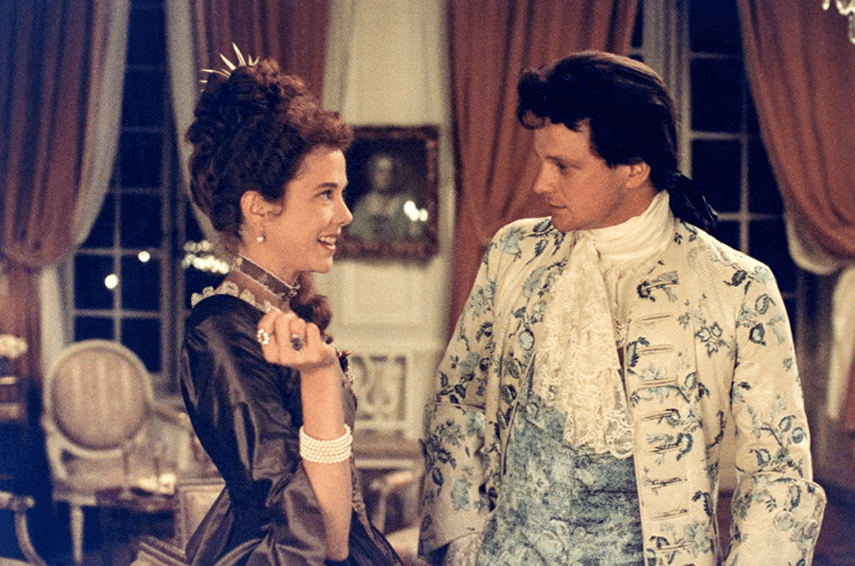
Les Liaisons Dangereuses is full of ambiguities; but on one point about the Valmont/Merteuil backstory, it is very clear. A footnote to Letter 2 in which the marquise asks Valmont to seduce Cécile de Volanges for revenge against her fiancé, the comte de Gercourt, informs us that Gercourt “had left the marquise de Merteuil for the intendante de ***, who had, in turn, given up the vicomte de Valmont for him, and it was then that the marquise and the vicomte became involved with each other.” (Those events, we’re told, “considerably preceded” the time frame of the novel.)
Meanwhile, here’s how Merteuil describes their history in the famous Letter 81, her autobiography and quasi-feminist manifesto, while discussing her “system” of precautions to protect her virtuous façade:
[R]ecall the time you first pursued me: no compliment had ever flattered me more; I desired you before I had even met you. Seduced by your reputation, I felt that without you my glory was not complete; I burned to wrestle with you one on one. It was the only time an attraction ever gained sway over me even for a moment. And yet had you wanted to ruin me, what means would you have found? Empty words that leave no trace, that your very same reputation would have helped render suspect; and a sequence of implausible facts a truthful account of which would have sounded like a badly plotted novel.
Letter 81
(“Wrestle with you one on one” is my version of vous combattre corps à corps, literally “combat you body to body,” variously translated as “measure swords with you” [P.W.K. Stone], “cross swords with you” [Helen Constantine], “come to grips with you” [Douglas Parmée] and “wrestle with you hand to hand” (Richard Aldington, 1924).
A later letter from Valmont contains another interesting clue to the early days of their liaison. At the end Letter 125, in which he recounts his “victory” over Madame de Tourvel—and eagerly anticipates a renewal of his relationship with Merteuil—Valmont writes: “Good-bye as in the old days… Yes, good-bye, my angel; I send you all of love’s kisses.” As Douglas Parmée writes in his notes to the 1995 Oxford University Press edition, “the italics suggest that Valmont is callously quoting from earlier letters to Merteuil written during their first love-affair.” Callous indeed, but this line also casts the “old days” of their affair in a surprisingly romantic light.
Merteuil’s later letters suggest the same—most explicitly in Letter 131, when she suggests sticking to their original deal of one night together but asks for a delay until she’s gotten rid of her ex-to-be Belleroche and taken a new lover so that their tryst can be a “reciprocal infidelity” as planned. Then, she suddenly slips into a wistful reflection:
Do you know that I sometimes regret having to resort to such devices? Back when we loved each other, for I do believe it was love, I was happy; and you, vicomte…! But why dwell on a happiness that can never come back? No, whatever you may say, such a return is impossible. Firstly I would demand sacrifices that you would be unable or unwilling to make for my sake, and which it is very possible I don’t deserve; and besides, how to keep you constant? Oh! no, no, I don’t even want to dwell on this idea; and as much as I’m enjoying writing to you right now, I much prefer to bid you good-bye abruptly. Adieu, vicomte.
Letter 131
This passage is obviously a manipulative tour de force, and one may ask whether a single word of it is sincere. But there does seem to be a touch of genuine feeling in “Back when we loved each other…”; perhaps, as is often the case with the duo, it’s a mix of manipulation and sincerity. Later, when Valmont tries to justify his relationship with Tourvel with the amusing excuse that he’s conducting an “experiment” (I swear, I was downloading the porn for research!) which requires making Tourvel “happy, perfectly happy” (Letter 133), she replies, “One might think you have never made any other woman happy, perfectly happy! Ah! If you doubt that, you must have a very bad memory” (Letter 134). Especially after Letter 131, that’s a clear allusion to herself. (Here, notably, Valmont does not answer.)
So we know that Valmont and Merteuil got to know each other after their respective lovers at the time left them to take up with each other. We know that they had, for some time, a relationship that both seem to remember as happy; we also know (from Valmont’s first letter to Merteuil, Letter 4) that at some point they made a mutual pact to separate, evidently because they decided they could not sacrifice their libertine career (or “mission of love”) for an exclusive relationship, and that this “eternal rupture” was sealed (in Merteuil’s words, in Letter 10) with a final lovemaking on an ottoman in Merteuil’s suburban love nest (petite maison).
Notably, after their sexual liaison ends, they settle not only into a private pact as allies in libertine adventures but into a public friendship. (Letter 47, in which he offers to accompany her to a reception at Madame de Volanges’s on his return to Paris, suggests that he often serves as her platonic date on social occasions.) This friendship also has a peculiar detail: both maintain the legend that the irresistible vicomte’s pursuit of the invincible marquise ended with her virtue victorious, and that Merteuil is the only woman who not only successfully resisted but successfully “friendzoned” him (or, as Madame de Volanges tells Tourvel in Letter 9, “she is the only one who was able to resist him and curb his malice.”
This legend obviously enhances Merteuil’s “glory”; but it’s useful to Valmont as well, allowing him to cultivate the public persona of a “player” who is nonetheless capable of decency and respect for women of good character. It works on Tourvel, who tells Mme de Volanges that Valmont often talks about Merteuil with “enthusiasm” and “true affection” and that surely “a man capable of such loyal friendship toward so worthy a woman is not an irredeemable libertine.”
Interestingly, just as the theme of Valmont’s love for Madame de Tourvel is present in the book from the very beginning, so is the theme of his desire to renew his relationship with the marquise:
This is not the first time, as you know, that I have regretted no longer being your slave; and, monster though you say I am, I can never recall without pleasure the times when you honored me with sweeter names. Indeed, I often feel a desire to earn them again and, in the end, give the world an example of constancy with you. But a greater purpose calls us; to conquer is our destiny; we must follow it. Perhaps at the end of the road we will meet again…
Letter 4
This could be simply the gallant language that is part of the duo’s game. However, a short time later, Merteuil easily provokes Valmont to jealousy by giving him an account of her sexual marathon with her lover, the Chevalier de Belleroche, at her suburban love nest or petite maison (“little house”)—and throws in a reference to sex “on the same ottoman where you and I once sealed so merrily, and in the same fashion, our eternal rupture” (Letter 10). Valmont readily takes the bait:
What’s this talk of eternal rupture? I renounce that vow, spoken in a delirious state: we would not have been worthy of making it if we’d been obliged to keep it. …
Look, my fair friend: as long as you share your bounties among several, I am not the least bit jealous: I see your lovers merely as Alexander’s successors, unable to preserve among all of them the empire where I reigned alone. But that you should give yourself entirely to one of them; that there should exist another man as happy as I—that, I will not suffer… Either take me back, or at least take another lover; do not betray, by an exclusive caprice, the inviolable friendship we have sworn to each other.
Letter 15
This passage, which leads to the Valmont/Merteuil “deal”—a tryst with Merteuil as his “prize” for success with Tourvel—certainly sounds more like pique than love. But it’s also worth noting that immediately after this paragraph, Valmont admits—slightly tongue-in-cheek, and perhaps in part to make Merteuil jealous in turn—that she is right and he really is (kind of) in love with Tourvel.
What does Valmont really want from Merteuil?
Once the “deal” is made, the libertine partnership/rivalry remains the primary Valmont/Merteuil dynamic for a while. But at one point, Valmont’s letter takes a sudden flirtatious and almost romantic turn:
While I am discoursing here, you’re doing something better with your chevalier. That reminds me you promised me an infidelity in my favor… I know payment is not yet due, but it would be very generous of you not to wait; on my part, I promise to keep track of the interest. What do you say, my fair friend? Aren’t you tired of your constancy? Is your chevalier really such a marvel? Oh! Give me a chance, and I will make you admit that if you have found some merit in him, it’s because you had forgotten me.
Good-bye, my fair friend, I kiss you as ardently as I desire you; I defy all of the chevalier’s kisses to have as much ardor.
Letter 57
Interestingly, this declaration follows closely after a thinly veiled admission of love for Tourvel (the passage, discussed in my previous post, in which Valmont notes that a libertine in love becomes less eager to pursue sex because he wants to prolong the unfamiliar enchantment—and cites himself as an example). Is the proximity accidental, or does Valmont fall back on sexual banter with Merteuil as a cover because he has revealed too much? Or does talking about his feelings toward Tourvel also put him in a more romantic mood toward Merteuil? (Notably, Merteuil does not respond.)
The next time Valmont mentions Merteuil’s promised reward, it’s after reporting that he is about to achieve his triumph with Tourvel:
Finally, my fair friend, I will be arriving at your doorstep very soon to hold you to your word. You surely haven’t forgotten what you promised me after my success: that infidelity to your chevalier? Are you ready? I, for one, desire it as if we had never known each other. But then again, to know you is perhaps a reason to desire it all the more.
I’m being just, not gallant in the least.
Also, this will be my first infidelity to my important conquest; and I promise you I will use the first available pretext to take leave of her for twenty-four hours. It will be her punishment for having kept me away from you for so long.
Letter 99
This passage is a remarkable mix of smugness and gallantry toward Merteuil—but, notably, at the end Valmont’s thoughts circle back to Tourvel.
Obviously, the smug self-assurance turns out to be misplaced when Tourvel abruptly leaves the château. But less than two weeks later (Letter 115), once again confident of success with Tourvel, Valmont also resumes his overtures to Merteuil—at first playfully offering himself “for [her] amusement” if she finds herself lacking in male company after returning to Paris from her stay in the country, but then, at the end, proposing to recover “the delicious pleasures of our first liaison” and suggesting that her expected win in her legal case would “occur under my reign.”
At the end of Letter 125 announcing the “conquest” of Tourvel, Valmont returns to this idea much more emphatically. “I hope I can assume that we’re agreed on the happy arrangement I proposed in my last letter,” he writes (and throws in that apparent quote from his old love letter to Merteuil). He is also, however, extraordinarily clumsy about it, telling Merteuil that she should dispatch Belleroche and forget Danceny “to give all your attention to me” while also informing her that “I’ll be able to give you a part of my time.” No wonder Merteuil’s reply is scathing (“What! me give up a fancy, and a new fancy at that … to wait my turn, like an obedient slave, for Your Highness‘s sublime favors!”). In his response, Valmont is apologetic and deferential, telling Merteuil that she misunderstood him and that he couldn’t possibly prefer Tourvel to her. He also ends with a remarkably romantic passage:
Say one word… I will fly to place myself at your feet and in your arms; I will prove to you a thousand times, in a thousand ways, that you are, that you will always be the true sovereign of my heart.
Letter 129
Besides the romanticism, the remarkable thing about this passage is how closely it echoes an earlier letter from Valmont to Tourvel:
I am only too happy to prove to you by a thousand means, just as I feel it in a thousand ways, that, myself not excepted, you are, you always will be the one thing dearest to my heart.
Letter 83
Is Valmont trying to redirect his feelings for Tourvel toward Merteuil—presumably a worthier love object as a fellow libertine and the only person he regards as his equal? (Letter 100: “In truth, the more I go on, the more I think that you and I are the only two people in the world who are worth anything.”) Notably, even as Valmont strenuously denies being in love with Tourvel and disparages love itself as a “weak-minded passion” that makes people stupid, he also repeatedly professes love for Merteuil; perhaps he believes that love for Tourvel violates his “principles” because it’s something he feels against his will, while love for Merteuil does not because it’s freely chosen. Indeed, when he reports to Merteuil that he sent Tourvel the breakup letter she scripted (Letter 142), he writes: “I’m curious, above all, whether you still see this latest act as evidence of love! Oh, it’s there, to be sure, and plenty of it! But for whom?”
In his next letter (144), amid growing anxiety that he has lost Tourvel forever, his tone toward Merteuil shifts back and forth from gallant/romantic (“I want to devote myself entirely to you”; “come back … to enjoy your dominion over me”) to transactional: he mentions, twice, that he is waiting to “collect [his] reward.” He does not reply to Merteuil’s brutal letter (145) in which she proclaims her victory over him and mocks his obvious hope to renew his relations with Tourvel (but seems to sweeten the pill at the end by assuring him that she still “loves [him] very much” and is “preparing to prove it”); he also starts making increasingly desperate attempts to reach Tourvel. His last letters to Merteuil before the “declaration of war”—and after he discovers her affair with Danceny—seem less about love than about bruised ego and demands to be given what he is owed. At the end of Letter 151, having discovered her deception, he writes: “Good-bye, marquise, I say nothing of my feelings for you. All I can do at this moment is refrain from examining my heart.”
Does Merteuil Love Valmont?
In the 1964 study, Form and Signification: Essays on Literary Structures from Corneille to Claudel, French literary scholar Jean Rousset writes that Les Liaisons Dangereuses is the ultimate “novel of love, of the triumph of love, in which every character loves despite a principle that forbids him or her to love: a religious principle for Mme de Tourvel, a libertine principle for Valmont and Mme de Merteuil.” Rousset argues that even Merteuil, “who so powerfully embodies the rejection of ‘natural sensibility'” and the subjection of emotion to reason, nonetheless ends up “yielding to murky forces that drive her: a love of sorts for Valmont and a violent jealousy with regard to Tourvel.”
It’s a love “of sorts,” to be sure. (But, as we have seen, Merteuil’s “principled” rejection of love is itself full of contradictions.) It’s very wrapped up in a battle of egos and in the duo’s need for each other as confidants. But just as Valmont is stung by Merteuil’s monogamous affair with Belleroche, Merteuil is stung from the start by the signs that Valmont is in love with Tourvel. (One interesting possibility is that jealousy toward Tourvel may trigger in her a more general sexual jealousy of Valmont: this may explain both her desire to ruin the vicomtesse de M. after Valmont recounts his adventure with her in Letter 71 and her sudden, intense hostility to Cécile after the latter’s sexual initiation by Valmont.)
If Merteuil does love Valmont in her own way, it also explains (paradoxically) her vehement rejection of him in Part 4 of the novel. Despite his protestations of love for her, he demonstrates, again and again, his love for Tourvel; he may seek a renewed relationship with Merteuil, but his own words repeatedly suggest that it will be auxiliary to his relationship with Tourvel. It says a great deal that the breakup letter Merteuil scripts for Valmont includes a declaration of passionate love for her (“Today, a woman I desperately love demands that I give you up”). But the letter, and Valmont’s subsequent behavior, ends up only further proving that he doesn’t love Merteuil as she wants to be loved: either he loves Tourvel and no one else, or he’s incapable of truly loving anyone and will always sacrifice love to his ego.
What Merteuil wants from Danceny could be a subject for a whole other essay, but one way of looking at it is that Danceny is meant to be her Tourvel. He’s young, idealistic and innocent; he will wholly love her “as one loves at his age” (Letter 127); just as Valmont writes that Tourvel has given him back “the charming illusions of youth,” Merteuil writes that she wants to present herself to Danceny as “pure and without stain; the kind of woman one would have to be to be truly worthy of him” (Letter 113). To be sure, she may be baiting Valmont, but the bait is also a deliberately crafted construct of attraction to purity.
This may also explain why Merteuil is sufficiently furious to lose her prudence when Valmont easily gets Danceny to ditch her for Cécile and then taunts her by pointing out that Danceny is capable of profound and constant love… just not for her. It comes across as a more general “no one loves you” taunt: Valmont won’t love her as he loves Tourvel; Danceny won’t love her as he loves Cécile, or as Tourvel loves Valmont.
Once the Valmont/Merteuil relationship breaks down, we lose Merteuil’s voice; we have no way of knowing what she feels when she learns of Valmont’s death. (Of course, Merteuil’s “voice” in her letters to Valmont is not always a reliable indicator of what she feels, either!) But the indirect evidence is fascinating: namely, the fact that Merteuil leaves for the country two or three days after Valmont is killed — causing her to be wholly ignorant of the fact that Danceny is circulating her letters (Letter 168).
My initial interpretation of her departure (which baffles Mme de Volanges, since it’s December and hardly anyone is going to the country at that point) was that she wants to avoid being linked to the duel. But on reflection, that would be a dumb move completely unlike Merteuil: she would understand that, on the contrary, such an unusual step would be likely to provoke suspicion. What seems far more likely is that Valmont’s death deeply shocks her: she undoubtedly expected Valmont to kill Danceny. (Besides revenge against Danceny for ditching her, this would also get Valmont in trouble, likely causing him to leave Paris at the very time he’s desperately trying to reach the dying Tourvel; Merteuil may even intuit that Valmont has enough rudiments of a conscience to feel some remorse for killing a man he so grievously wronged.) The only real reason to leave Paris, surely, is that she wants to be alone in the countryside to give full vent to her anger and pain at Valmont’s death rather than endure the gossip about it in her social circle.
If that’s the case, her feelings for Valmont contribute in several ways to her undoing.
 Reading Liaisons