I was excited when I found out about a year ago that a new stage adaptation of Les Liaisons Dangereuses was going to be produced at the Comédie des Champs-Elysées, a private theater in Paris. I’m not the greatest fan of the Christopher Hampton play, which I’ve seen on stage twice (including the first production with Alan Rickman), for several reasons — one of which is that reinventing Valmont’s Merteuil-scripted breakup letter to Madame de Tourvel as an in-person breakup, with “It’s beyond my control” as the only cue from Merteuil, doesn’t really work for me. (The more I think about it, the more I’m convinced that the novel’s Valmont doesn’t quite realize what he’s doing in sending the letter. Also, “It’s beyond my control” is not a good substitute for Ce n’est pas ma faute.)
So, new stage adaptation! Exciting! I was disappointed when I thought I wouldn’t be able to see it; it was originally set to close December 31 of last year and there was just no way I could get to Paris before then. Then it got extended until the end of April and I was trying to work something out (with some logistical difficulty since I was supposed to be in London in late May), and then, o joy! It got extended again until the end of July. Obviously the extensions meant that it was popular. The reviews were good, and it got nominated for several prestigious Molière awards (with Delphine Depardieu, Gerard Depardieu’s niece, winning the one for Best Actress, private theater).
Reader, I saw it.
And … oh man. Depardieu is good. Valentin de Carbonnières has his moments as Valmont. Salomé de Villiers as Madame de Tourvel is kind of okay, but the role is so thin that there’s almost nothing left of it. The adaptation makes Hampton look like Shakespeare.
There are, for one, major and odd changes to the plot that totally change the character dynamics. Danceny is now Merteuil’s boy-toy lover from the start (his character is now an amalgam of Danceny and Belleroche), though he still has his puppy-love romance with Cécile. For some reason Merteuil is also having sex with her valet. Madame de Volanges, said to be forever ailing, is excised from the story altogether, and the role of telling Tourvel that Valmont is a dangerous scoundrel is given to his aunt, Madame de Rosemonde, who explains that she nonetheless receives her rascally nephew at the château because “he amuses her.” The gradual development of the Valmont/Tourvel relationship — his departure from the château at her request, his return, their growing intimacy, her near-surrender and panicked flight to Paris, his subterfuge to obtain a meeting with her by claiming that he wants to return her letters and make amends before embracing religion — is dropped completely. Instead, what happens is something like this:
Valmont: I’m madly in love with your beauty and virtue. Tourvel: These feelings offend me. Don’t ever speak of them again, monsieur.
(some time later)
Valmont to Merteuil: I moved too fast and failed with her. But I have a backup plan. I will appeal to her compassion.
Valmont to Tourvel, looking dejected: Ah, why do you hate me, madame? Tourvel: I don’t hate you at all! I want you to be happy. Valmont: But you don’t love me! How can I ever be happy? Okay, I’m going to kill myself. Good-bye. Tourvel: No no, I beg you, don’t go! (throws her arms around him and collapses into his arms) From now on I am entirely yours, with no refusals or regrets.
(passionate kiss)
Yes, I exaggerate, but only slightly.
And then there’s the marquise de Merteuil. Again, Depardieu is a fine actress, and she is delightful when she turns her voice to a dangerously silky sing-song. Unfortunately, whether it’s her idea or the producer’s, much of her time is spent barking and yelling (especially in her interaction with both Valmont and Danceny). Also, in this version, her quest for power and vengeance is given the fashionable motive of trauma, specifically, the trauma of marital rape. In her monologue recounting her life story to Valmont (the equivalent of Letter 81), the marquise suddenly lapses into a hurt, tremulous tone when describing her wedding night — which the novel’s Merteuil says she saw only as an opportunity to learn. This Merteuil, suddenly wide-eyed with PTSD, recounts in a half-whisper, “I remember his breath on my face, the weight of his stomach on me.” This makes especially little sense since only a few moments earlier Merteuil was discussing her achievement of steely self-discipline as a child, when she trained herself to smile pleasantly while jabbing her hand with a fork under the table. (Oh, and Merteuil’s statement that her principles are truly her own and not acquired by accident and followed out of habit like those of other women are for some reason transferred to her earlier scene with Danceny. What?)
Valmont’s Merteuil-instigated breakup with Tourvel is handled far worse than in the Hampton version, which at least preserves the format of Merteuil slyly telling Valmont a story about a “friend of hers” who also got involved with an unsuitable woman and needed a female friend’s advice to break it off. Here, Merteuil explicitly demands that Valmont break up with Tourvel as the price of a renewed relationship with her. Ce n’est pas ma faute also gets a radically different meaning. In the novel, Merteuil seizes on a passing phrase by which Valmont seeks to explain why he needs to play the role of Tourvel’s devoted lover and transforms it, with pointed and mocking cruelty, into the means of Valmont’s breakup with Tourvel. In the play, it was something Valmont said to Merteuil during their breakup while trying to excuse his misdeeds. She still feels hurt by it. So she now demands that Valmont say it to Tourvel, and not once but multiple times. (He later reports to her that it was “at least six.”) When Merteuil nonetheless rejects Valmont because she can see that he still loves Tourvel, the duo’s quarrel turns into a shouting match in which Valmont throws Merteuil to the floor and also rips off her wig and drags her to the mirror; since his shouted, sputtering lines are barely comprehensible, I wasn’t sure if he’s telling her that she’s getting old or that her hideous soul is visible in her face. (There is so much yelling in this production that it might as well be “Les Liaisons Dangereuses as written by Dostoyevsky, minus discussions of God and the destiny of Russia.”)
Along the way, there’s the Cécile subplot. The scene of Cécile’s sexual initiation is here less physically coercive and more manipulative than in the book or the Hampton play, but it still manages to be repulsively sleazy as the play’s Valmont cajoles Cécile into showing him her breasts (they’re both sitting with their backs to the audience), drools over how pretty they are, and then puts her hand on his crotch and inquires, “Can you feel my snake rearing up?” Errr … okay. There’s more crude humor of this sort in this adaptation: after surprising Cécile in a tête-a-tête with Danceny, Merteuil asks if Danceny has “shown her his nasty part” (Cécile: “The chevalier Danceny has a nasty part?”) and assures her that all is well as long as he didn’t put his “nasty part” in her “pleasure cave.” She also jokes about Gercourt, Cécile’s intended against whom she has a grudge, having a “snake” of unsatisfactory size. I feel dumber just typing this out.
At the end, Cécile has her miscarriage at Rosemonde’s château; Tourvel also dies there in Rosemonde’s care, but not before learning that Valmont did have a heart and it was hers, because she receives from him a “by the time you read this, I’ll be dead” letter explaining that he has lost everything when he lost her and he’s about to get himself killed, on purpose, in a duel. Tourvel dies. Merteuil learns of Valmont’s death and her disgrace from Danceny. Alone and despairing, she suddenly sees candles light up at the front of the stage where Valmont’s dead body, laid out on a bier, emerges from the darkness. A terrified Merteuil claws helplessly at the air. Suddenly, we’ve segued into the horror genre. Curtain call. Nice costumes?
Maybe I’m not getting something. Why this adaptation? Why is it so popular? Have the critics who praise it actually read Les Liaisons Dangereuses? Should I revise my opinion of French culture writers downward? And when are we going to get an actual good adaptation of Liaisons?
Annette Benning and Colin Firth as “the infernal couple” in Milos Forman’s 1989 Valmont. Muddled concept, but physically, much closer to the way Merteuil and Valmont should be than Glenn Close and John Malkovich.
Les Liaisons Dangereuses is full of ambiguities; but on one point about the Valmont/Merteuil backstory, it is very clear. A footnote to Letter 2 in which the marquise asks Valmont to seduce Cécile de Volanges for revenge against her fiancé, the comte de Gercourt, informs us that Gercourt “had left the marquise de Merteuil for the intendante de ***, who had, in turn, given up the vicomte de Valmont for him, and it was then that the marquise and the vicomte became involved with each other.” (Those events, we’re told, “considerably preceded” the time frame of the novel.)
Meanwhile, here’s how Merteuil describes their history in the famous Letter 81, her autobiography and quasi-feminist manifesto, while discussing her “system” of precautions to protect her virtuous façade:
[R]ecall the time you first pursued me: no compliment had ever flattered me more; I desired you before I had even met you. Seduced by your reputation, I felt that without you my glory was not complete; I burned to wrestle with you one on one. It was the only time an attraction ever gained sway over me even for a moment. And yet had you wanted to ruin me, what means would you have found? Empty words that leave no trace, that your very same reputation would have helped render suspect; and a sequence of implausible facts a truthful account of which would have sounded like a badly plotted novel.
Letter 81
(“Wrestle with you one on one” is my version of vous combattre corps à corps, literally “combat you body to body,” variously translated as “measure swords with you” [P.W.K. Stone], “cross swords with you” [Helen Constantine], “come to grips with you” [Douglas Parmée] and “wrestle with you hand to hand” (Richard Aldington, 1924).
A later letter from Valmont contains another interesting clue to the early days of their liaison. At the end Letter 125, in which he recounts his “victory” over Madame de Tourvel—and eagerly anticipates a renewal of his relationship with Merteuil—Valmont writes: “Good-bye as in the old days… Yes, good-bye, my angel; I send you all of love’s kisses.” As Douglas Parmée writes in his notes to the 1995 Oxford University Press edition, “the italics suggest that Valmont is callously quoting from earlier letters to Merteuil written during their first love-affair.” Callous indeed, but this line also casts the “old days” of their affair in a surprisingly romantic light.
Merteuil’s later letters suggest the same—most explicitly in Letter 131, when she suggests sticking to their original deal of one night together but asks for a delay until she’s gotten rid of her ex-to-be Belleroche and taken a new lover so that their tryst can be a “reciprocal infidelity” as planned. Then, she suddenly slips into a wistful reflection:
Do you know that I sometimes regret having to resort to such devices? Back when we loved each other, for I do believe it was love, I was happy; and you, vicomte…! But why dwell on a happiness that can never come back? No, whatever you may say, such a return is impossible. Firstly I would demand sacrifices that you would be unable or unwilling to make for my sake, and which it is very possible I don’t deserve; and besides, how to keep you constant? Oh! no, no, I don’t even want to dwell on this idea; and as much as I’m enjoying writing to you right now, I much prefer to bid you good-bye abruptly. Adieu, vicomte.
Letter 131
This passage is obviously a manipulative tour de force, and one may ask whether a single word of it is sincere. But there does seem to be a touch of genuine feeling in “Back when we loved each other…”; perhaps, as is often the case with the duo, it’s a mix of manipulation and sincerity. Later, when Valmont tries to justify his relationship with Tourvel with the amusing excuse that he’s conducting an “experiment” (I swear, I was downloading the porn for research!) which requires making Tourvel “happy, perfectly happy” (Letter 133), she replies, “One might think you have never made any other woman happy, perfectly happy! Ah! If you doubt that, you must have a very bad memory” (Letter 134). Especially after Letter 131, that’s a clear allusion to herself. (Here, notably, Valmont does not answer.)
So we know that Valmont and Merteuil got to know each other after their respective lovers at the time left them to take up with each other. We know that they had, for some time, a relationship that both seem to remember as happy; we also know (from Valmont’s first letter to Merteuil, Letter 4) that at some point they made a mutual pact to separate, evidently because they decided they could not sacrifice their libertine career (or “mission of love”) for an exclusive relationship, and that this “eternal rupture” was sealed (in Merteuil’s words, in Letter 10) with a final lovemaking on an ottoman in Merteuil’s suburban love nest (petite maison).
Notably, after their sexual liaison ends, they settle not only into a private pact as allies in libertine adventures but into a public friendship. (Letter 47, in which he offers to accompany her to a reception at Madame de Volanges’s on his return to Paris, suggests that he often serves as her platonic date on social occasions.) This friendship also has a peculiar detail: both maintain the legend that the irresistible vicomte’s pursuit of the invincible marquise ended with her virtue victorious, and that Merteuil is the only woman who not only successfully resisted but successfully “friendzoned” him (or, as Madame de Volanges tells Tourvel in Letter 9, “she is the only one who was able to resist him and curb his malice.”
This legend obviously enhances Merteuil’s “glory”; but it’s useful to Valmont as well, allowing him to cultivate the public persona of a “player” who is nonetheless capable of decency and respect for women of good character. It works on Tourvel, who tells Mme de Volanges that Valmont often talks about Merteuil with “enthusiasm” and “true affection” and that surely “a man capable of such loyal friendship toward so worthy a woman is not an irredeemable libertine.”
Interestingly, just as the theme of Valmont’s love for Madame de Tourvel is present in the book from the very beginning, so is the theme of his desire to renew his relationship with the marquise:
This is not the first time, as you know, that I have regretted no longer being your slave; and, monster though you say I am, I can never recall without pleasure the times when you honored me with sweeter names. Indeed, I often feel a desire to earn them again and, in the end, give the world an example of constancy with you. But a greater purpose calls us; to conquer is our destiny; we must follow it. Perhaps at the end of the road we will meet again…
Letter 4
This could be simply the gallant language that is part of the duo’s game. However, a short time later, Merteuil easily provokes Valmont to jealousy by giving him an account of her sexual marathon with her lover, the Chevalier de Belleroche, at her suburban love nest or petite maison (“little house”)—and throws in a reference to sex “on the same ottoman where you and I once sealed so merrily, and in the same fashion, our eternal rupture” (Letter 10). Valmont readily takes the bait:
What’s this talk of eternal rupture? I renounce that vow, spoken in a delirious state: we would not have been worthy of making it if we’d been obliged to keep it. …
Look, my fair friend: as long as you share your bounties among several, I am not the least bit jealous: I see your lovers merely as Alexander’s successors, unable to preserve among all of them the empire where I reigned alone. But that you should give yourself entirely to one of them; that there should exist another man as happy as I—that, I will not suffer… Either take me back, or at least take another lover; do not betray, by an exclusive caprice, the inviolable friendship we have sworn to each other.
Letter 15
This passage, which leads to the Valmont/Merteuil “deal”—a tryst with Merteuil as his “prize” for success with Tourvel—certainly sounds more like pique than love. But it’s also worth noting that immediately after this paragraph, Valmont admits—slightly tongue-in-cheek, and perhaps in part to make Merteuil jealous in turn—that she is right and he really is (kind of) in love with Tourvel.
What does Valmont really want from Merteuil?
Once the “deal” is made, the libertine partnership/rivalry remains the primary Valmont/Merteuil dynamic for a while. But at one point, Valmont’s letter takes a sudden flirtatious and almost romantic turn:
While I am discoursing here, you’re doing something better with your chevalier. That reminds me you promised me an infidelity in my favor…I know payment is not yet due, but it would be very generous of you not to wait; on my part, I promise to keep track of the interest. What do you say, my fair friend? Aren’t you tired of your constancy? Is your chevalier really such a marvel? Oh! Give me a chance, and I will make you admit that if you have found some merit in him, it’s because you had forgotten me.
Good-bye, my fair friend, I kiss you as ardently as I desire you; I defy all of the chevalier’s kisses to have as much ardor.
Letter 57
Interestingly, this declaration follows closely after a thinly veiled admission of love for Tourvel (the passage, discussed in my previous post, in which Valmont notes that a libertine in love becomes less eager to pursue sex because he wants to prolong the unfamiliar enchantment—and cites himself as an example). Is the proximity accidental, or does Valmont fall back on sexual banter with Merteuil as a cover because he has revealed too much? Or does talking about his feelings toward Tourvel also put him in a more romantic mood toward Merteuil? (Notably, Merteuil does not respond.)
The next time Valmont mentions Merteuil’s promised reward, it’s after reporting that he is about to achieve his triumph with Tourvel:
Finally, my fair friend, I will be arriving at your doorstep very soon to hold you to your word. You surely haven’t forgotten what you promised me after my success: that infidelity to your chevalier? Are you ready? I, for one, desire it as if we had never known each other. But then again, to know you is perhaps a reason to desire it all the more.
I’m being just, not gallant in the least.
Also, this will be my first infidelity to my important conquest; and I promise you I will use the first available pretext to take leave of her for twenty-four hours. It will be her punishment for having kept me away from you for so long.
Letter 99
This passage is a remarkable mix of smugness and gallantry toward Merteuil—but, notably, at the end Valmont’s thoughts circle back to Tourvel.
Obviously, the smug self-assurance turns out to be misplaced when Tourvel abruptly leaves the château. But less than two weeks later (Letter 115), once again confident of success with Tourvel, Valmont also resumes his overtures to Merteuil—at first playfully offering himself “for [her] amusement” if she finds herself lacking in male company after returning to Paris from her stay in the country, but then, at the end, proposing to recover “the delicious pleasures of our first liaison” and suggesting that her expected win in her legal case would “occur under my reign.”
At the end of Letter 125 announcing the “conquest” of Tourvel, Valmont returns to this idea much more emphatically. “I hope I can assume that we’re agreed on the happy arrangement I proposed in my last letter,” he writes (and throws in that apparent quote from his old love letter to Merteuil). He is also, however, extraordinarily clumsy about it, telling Merteuil that she should dispatch Belleroche and forget Danceny “to give all your attention to me” while also informing her that “I’ll be able to give you a part of my time.” No wonder Merteuil’s reply is scathing (“What! me give up a fancy, and a new fancy at that … to wait my turn, like an obedient slave, for Your Highness‘s sublime favors!”). In his response, Valmont is apologetic and deferential, telling Merteuil that she misunderstood him and that he couldn’t possibly prefer Tourvel to her. He also ends with a remarkably romantic passage:
Say one word… I will fly to place myself at your feet and in your arms; I will prove to you a thousand times, in a thousand ways, that you are, that you will always be the true sovereign of my heart.
Letter 129
Besides the romanticism, the remarkable thing about this passage is how closely it echoes an earlier letter from Valmont to Tourvel:
I am only too happy to prove to you by a thousand means, just as I feel it in a thousand ways, that, myself not excepted, you are, you always will be the one thing dearest to my heart.
Letter 83
Is Valmont trying to redirect his feelings for Tourvel toward Merteuil—presumably a worthier love object as a fellow libertine and the only person he regards as his equal? (Letter 100: “In truth, the more I go on, the more I think that you and I are the only two people in the world who are worth anything.”) Notably, even as Valmont strenuously denies being in love with Tourvel and disparages love itself as a “weak-minded passion” that makes people stupid, he also repeatedly professes love for Merteuil; perhaps he believes that love for Tourvel violates his “principles” because it’s something he feels against his will, while love for Merteuil does not because it’s freely chosen. Indeed, when he reports to Merteuil that he sent Tourvel the breakup letter she scripted (Letter 142), he writes: “I’m curious, above all, whether you still see this latest act as evidence of love! Oh, it’s there, to be sure, and plenty of it! But for whom?”
In his next letter (144), amid growing anxiety that he has lost Tourvel forever, his tone toward Merteuil shifts back and forth from gallant/romantic (“I want to devote myself entirely to you”; “come back … to enjoy your dominion over me”) to transactional: he mentions, twice, that he is waiting to “collect [his] reward.” He does not reply to Merteuil’s brutal letter (145) in which she proclaims her victory over him and mocks his obvious hope to renew his relations with Tourvel (but seems to sweeten the pill at the end by assuring him that she still “loves [him] very much” and is “preparing to prove it”); he also starts making increasingly desperate attempts to reach Tourvel. His last letters to Merteuil before the “declaration of war”—and after he discovers her affair with Danceny—seem less about love than about bruised ego and demands to be given what he is owed. At the end of Letter 151, having discovered her deception, he writes: “Good-bye, marquise, I say nothing of my feelings for you. All I can do at this moment is refrain from examining my heart.”
Does Merteuil Love Valmont?
In the 1964 study, Form and Signification: Essays on Literary Structures from Corneille to Claudel, French literary scholar Jean Rousset writes that Les Liaisons Dangereuses is the ultimate “novel of love, of the triumph of love, in which every character loves despite a principle that forbids him or her to love: a religious principle for Mme de Tourvel, a libertine principle for Valmont and Mme de Merteuil.” Rousset argues that even Merteuil, “who so powerfully embodies the rejection of ‘natural sensibility'” and the subjection of emotion to reason, nonetheless ends up “yielding to murky forces that drive her: a love of sorts for Valmont and a violent jealousy with regard to Tourvel.”
It’s a love “of sorts,” to be sure. (But, as we have seen, Merteuil’s “principled” rejection of love is itself full of contradictions.) It’s very wrapped up in a battle of egos and in the duo’s need for each other as confidants. But just as Valmont is stung by Merteuil’s monogamous affair with Belleroche, Merteuil is stung from the start by the signs that Valmont is in love with Tourvel. (One interesting possibility is that jealousy toward Tourvel may trigger in her a more general sexual jealousy of Valmont: this may explain both her desire to ruin the vicomtesse de M. after Valmont recounts his adventure with her in Letter 71 and her sudden, intense hostility to Cécile after the latter’s sexual initiation by Valmont.)
If Merteuil does love Valmont in her own way, it also explains (paradoxically) her vehement rejection of him in Part 4 of the novel. Despite his protestations of love for her, he demonstrates, again and again, his love for Tourvel; he may seek a renewed relationship with Merteuil, but his own words repeatedly suggest that it will be auxiliary to his relationship with Tourvel. It says a great deal that the breakup letter Merteuil scripts for Valmont includes a declaration of passionate love for her (“Today, a woman I desperately love demands that I give you up”). But the letter, and Valmont’s subsequent behavior, ends up only further proving that he doesn’t love Merteuil as she wants to be loved: either he loves Tourvel and no one else, or he’s incapable of truly loving anyone and will always sacrifice love to his ego.
What Merteuil wants from Danceny could be a subject for a whole other essay, but one way of looking at it is that Danceny is meant to be her Tourvel. He’s young, idealistic and innocent; he will wholly love her “as one loves at his age” (Letter 127); just as Valmont writes that Tourvel has given him back “the charming illusions of youth,” Merteuil writes that she wants to present herself to Danceny as “pure and without stain; the kind of woman one would have to be to be truly worthy of him” (Letter 113). To be sure, she may be baiting Valmont, but the bait is also a deliberately crafted construct of attraction to purity.
This may also explain why Merteuil is sufficiently furious to lose her prudence when Valmont easily gets Danceny to ditch her for Cécile and then taunts her by pointing out that Danceny is capable of profound and constant love… just not for her. It comes across as a more general “no one loves you” taunt: Valmont won’t love her as he loves Tourvel; Danceny won’t love her as he loves Cécile, or as Tourvel loves Valmont.
Once the Valmont/Merteuil relationship breaks down, we lose Merteuil’s voice; we have no way of knowing what she feels when she learns of Valmont’s death. (Of course, Merteuil’s “voice” in her letters to Valmont is not always a reliable indicator of what she feels, either!) But the indirect evidence is fascinating: namely, the fact that Merteuil leaves for the country two or three days after Valmont is killed — causing her to be wholly ignorant of the fact that Danceny is circulating her letters (Letter 168).
My initial interpretation of her departure (which baffles Mme de Volanges, since it’s December and hardly anyone is going to the country at that point) was that she wants to avoid being linked to the duel. But on reflection, that would be a dumb move completely unlike Merteuil: she would understand that, on the contrary, such an unusual step would be likely to provoke suspicion. What seems far more likely is that Valmont’s death deeply shocks her: she undoubtedly expected Valmont to kill Danceny. (Besides revenge against Danceny for ditching her, this would also get Valmont in trouble, likely causing him to leave Paris at the very time he’s desperately trying to reach the dying Tourvel; Merteuil may even intuit that Valmont has enough rudiments of a conscience to feel some remorse for killing a man he so grievously wronged.) The only real reason to leave Paris, surely, is that she wants to be alone in the countryside to give full vent to her anger and pain at Valmont’s death rather than endure the gossip about it in her social circle.
If that’s the case, her feelings for Valmont contribute in several ways to her undoing.
From Georges Barbier’s illustrations to the 1934 special edition of Les Liaisons Dangereuses
Are you really, vicomte, deluding yourself about the feeling that binds you to Mme de Tourvel? If it isn’t love, then love doesn’t exist: you deny it in a hundred ways but prove it in a thousand.
The Marquise de Merteuil to the Vicomte de Valmont, Letter 134
“Does Valmont love Madame de Tourvel?” is one of the big enduring questions of Liaisons scholarship, and one of the novel’s great ambiguities. Does the cold and jaded libertine get caught in his own trap when his faked love for his victim becomes real? Or is Valmont incapable of love, at least as most of us would understand the term? Is whatever he feels simply a glorified ego trip? Does Tourvel remain nothing but his “project,” or even a “chess piece” in his game with Merteuil?
Obviously, the answer is hugely relevant to our understanding of the novel. If Valmont does fall in love—and, as literary critic Peter Brooks argues in his 1969 book, The Novel of Worldliness, briefly experiences something beyond the empty, hedonistic “worldliness” of his social circle, before he recklessly destroys everything—this makes the conclusion, and the novel itself, far more tragic but also more human and in some sense hopeful. If he always remains a libertine with a project, the novel is almost relentlessly dark and cynical (and even Tourvel’s deathbed prayer for Valmont’s soul becomes a joke, since this Valmont clearly has no soul).
The question of love is there from the start
Here’s an interesting detail that I think many readers miss (and that is completely missing from the 1989 film adaptation): The possibility that Valmont is in love with Tourvel is brought up very early on. In his very first letter to Merteuil in which he refuses her “orders” to return to Paris and seduce Cécile because he’s embarked on the conquest of Tourvel, he remarks, “I really must have this woman to save myself from the ridiculous position of falling in love with her, for who knows where thwarted desire could lead!” (Letter 4). In her response (Letter 5), Merteuil mocks Valmont’s pursuit of Tourvel as a “ridiculous whim” and then nastily mocks Tourvel herself: a passably attractive woman, to be sure, but bland-faced, graceless, awkward, badly dressed, and a prude who is certain to be a total dud in bed even if Valmont does manage to coax her there (at best, she’ll grant him the same boring sex she has with her husband). Valmont responds with a passionate defense of Tourvel, half-jokingly asserting that any man who spoke of her that way “would pay with his life” and any other woman but Merteuil would suffer some kind of payback.
In the name of friendship, wait until I’ve had this woman if you want to malign her. Don’t you know that only pleasure has the right to remove love’s blindfold?
But what am I saying? Is Mme de Tourvel in need of any illusion? No, all she needs to be adorable is to be herself.
Letter 6
An enthusiastic and even lyrical paean to Tourvel follows: Sure she may look dowdy in formal attire, but she’s ravishing in the casual morning dress she wears in the countryside on oppressively hot days! Sure her face has no expression when “nothing speaks to her heart,” because she doesn’t have the “lying gaze” or studied smile of the coquette—but if you could only see her “frank and artless merriment” in playful moments, or the way her face lights up with “pure joy and sympathetic kindness” when she is helping some unfortunate! This is also where Valmont rhapsodizes (see earlier post) about being able to feel again and recovering the “charming illusions of youth” next to Tourvel, with whom he doesn’t need sexual possession to be happy.
No wonder Merteuil responds by telling him he’s in love. (“To tell you otherwise would be to deceive you; it would be to hide your illness from you.”) Interestingly, Valmont quickly concedes: “If being unable to live without possessing the object of desire; if giving up all other pleasures for this pursuit and letting it consume all of one’s time and one’s life means being in love, then I am really and truly in love.” This is very different from his later defensiveness about being in love with Tourvel—perhaps because infatuation with a still-unattainable “object of desire” is perfectly acceptable as part of the libertine game.
Hints of real feeling—with a dark side
After that, there are recurring clues that Valmont’s feelings are more real than he generally admits. His first declaration of love is thoroughly calculated—he pretends to blurt out his confession on impulse during a conversation he has carefully set up with his act of charity toward a peasant family—but he also notes that when Tourvel bursts into tears, “fortunately I got so carried away that I too was crying.” (Letter 23) A little later, when he manages to get his hands on Tourvel’s mail and discovers evidence of her feelings for him (his letter which she conspicuously tore up has been carefully put back together, with traces of tears on the paper), he tells Merteuil, “I confess, I yielded to a young man’s impulse and kissed this letter with a surge of emotion to which I thought I was no longer susceptible.” For good measure, he also refers to Tourvel in this passage as “the woman I adore.” (Letter 44)
An even more remarkable passage occurs when Valmont discusses his conversation with Danceny about the latter’s feelings for Cécile and points out that when a man is in love for the first time, he will be less eager to seek sex, and not out of timidity or scruples:
[I]t’s that the heart, surprised by an unfamiliar feeling, pauses, so to speak, at each step to bask in the enchantment it feels, and this enchantment has such a powerful effect on a novice heart as to make it forget all other pleasures. This is so true that a libertine in love—if a libertine can be in love—becomes from that very moment less impatient to obtain possession; and in the end, between Danceny’s behavior with the Volanges girl and my own with the prudish Mme de Tourvel, the difference is only one of degree.
Letter 57
In a 1980 article in the journal Romance Notes (v. 3, No. 2, Spring 1980) arguing that Valmont always remains “a man with a project,” Raymond Lemieux, professor of foreign languages at Sonoma State University in California, highlights the phrase “if a libertine can be in love” as evidence that Valmont himself acknowledges he is not, and cannot be. But for one thing, the disclaimer does acknowledge the possibility of love; for another, it sounds more than anything else like a face-saving way to hedge.
Is Valmont, to some extent, talking himself into being in love by playing the part too well? It’s worth noting he plays it not only for Tourvel herself but also for Danceny, in order to win the young man’s confidence (and advance the agenda of Cécile’s seduction):
I told him so many times that honorable love is the highest good, that a genuine feeling is worth a dozen dalliances, that I myself was at the moment in love and shy, and he finally found my way of thinking so congenial to his own that, charmed by my candor, he told me everything and swore to me a friendship without reserve.
Letter 57
(Doug Parmée and Helen Constantine both garble this passage to suggest that Valmont makes such a convincing spiel to Danceny that he himself starts to feel like “a timid lover” or a “shy young lover.” It’s an interesting idea, and it goes with the more general theme of Valmont falling in love by getting too deeply into his role. But it’s not in the original text.)
Obviously, Valmont’s lyrical effusions about Tourvel don’t change the fact that his pursuit of her has a much darker side, even aside from the manipulation and deception. In a much-discussed passage in Letter 6, Valmont tells Merteuil that he doesn’t want to rid Tourvel of her religious “prejudices” but, rather, to be “by turns the object and the conqueror of her remorse”:
Let her believe in virtue but sacrifice it to me; let her be appalled by her transgressions yet powerless to stop herself; agitated by a myriad terrors, let her only be able to forget them and vanquish them in my arms. Then she can say, with my consent: “I adore you”; she alone of all women will deserve to say it. I will indeed be the god she has chosen.
Some critics see this passage as sadistic; but note that Valmont’s fantasy involves soothing Tourvel’s anguish, as well as causing it. (It’s basically a combination of hurt/comfort—to use a term from fanfiction—and massive ego trip.) Incidentally, this passage in the manuscript originally had another revealing line (found in the “variants” in the 2011 Bibliothèque de la Pléiade edition, p. 813): “Ah, don’t accuse me of being a brute; the fleeting pain will only double her pleasures.” (Laclos dropped it, no doubt, because it’s unlikely that Valmont would justify himself to Merteuil on the charge of excessive cruelty.) As with much else, Valmont’s language about Tourvel at that point is riddled with contradictions: he is both plotting her undoing and contemplating “her happiness and my own” (Letter 4).
“I love and hate with equal ardor”
A turning point comes in Letters 99-100. In a key scene, Tourvel nearly capitulates and starts telling Valmont that she loves him; then, she falls at his feet sobbing and begging him to “save her.” “Deeply moved” (as he admits to Merteuil), he lifts her up, carries her to the bed while she seems to go into shock—her body stiffens, and she is shaking violently—and leaves her after “rendering some assistance” (presumably undoing her corset). Valmont’s emotion here seems quite genuine; he even tells Merteuil, hours later, that he is still under its sway and has set out to write to her partly to “force himself” to shake it off. Yet he also quickly segues to smug certainty that, after these “death throes of virtue,” Tourvel’s surrender is imminent—all the more so since, when a recovered but subdued Tourvel reappears in the drawing-room that evening, she gives Valmont very tender looks and impulsively squeezes his hand as she bids him goodnight.
Valmont is not exactly sympathetic here: he’s convinced that his chivalrous self-restraint has earned him enough credit to clinch his victory (what better proof that he really has abandoned his libertine ways and is the respectful admirer he promised to be!); he’s ridiculously self-satisfied, and he is already nagging Merteuil for his prize (“Are you ready?”). But he’s also envisioning Tourvel’s surrender in benign and even tender terms: “I bet she is delighted to be where she is. All the dues have been paid; all that remains is to enjoy the reward. Perhaps, even as I write to you, she is already pondering this sweet thought.”
In the very next letter, Letter 100, the other shoe drops: “My friend, I have been played, betrayed, ruined; I am in despair.” Tourvel has left the château and fled back to Paris in the middle of the night. This sends Valmont into a rage, both frightening and comically over the top, that shows far more wounded vanity and thwarted entitlement than love:
How I will enjoy my revenge! … I will yet see her at my feet, trembling and bathed in tears, crying for mercy in that lying voice of hers; and I will have no mercy.
What is she doing now? what is she thinking? Perhaps she’s congratulating herself on having tricked me and, true to the predilections of her sex, finds this to be the sweetest pleasure of all. …
And to be forced to swallow my resentment! not to dare show anything but tender anguish when my heart is filled with rage! to see myself reduced to pleading yet again with a rebellious woman who has escaped my dominion! Did I have to be humiliated like this? And by whom? by a timid woman with no experience of combat! … And I’m going to tolerate it? My friend, you do not believe that; you do not have such a humiliating opinion of me.
This letter (which alone should refute some commentators’ bizarre idea that Valmont and Merteuil are both creatures of icy intellect!) also reveals the intensity of Valmont’s obsession:
But what fatal power draws me to this woman? … There is no more happiness for me, no more peace, unless I can possess this woman whom I love and hate with equal ardor. My life will be unbearable until her life is in my hands.
Two weeks later, reassured (by secretly reading Tourvel’s letters to his aunt, Mme de Rosemonde) that his “fair lady” is still passionately in love with him, tormented by guilt, anxiety and longing, and ready to succumb as soon as he can get near her, Valmont is still having some vindictive thoughts about making her suffer and beg for his attention. But this passage also has a particularly interesting line:
I’ll do more; I’ll leave her, and either I don’t know this woman, or I’ll have no successor. She will resist the need for consolation, the habit of pleasure, even the desire for revenge. In the end she will have existed only for me, and whether she’ll have a long or short run, I alone will have opened and shut the gate.
Letter 115
Leave aside the usual grandiosity and posturing, and what stands out is Valmont’s need to spell out that he’ll drop Tourvel at some point. (Note that he doesn’t say, for instance, “And once I leave her, I’m willing to bet I’ll have no successor.”) But isn’t that the presumed conclusion to any libertine adventure? Thus, paradoxically, this very statement implies that not leaving her is a possibility—quite a leap for a man like Valmont.
Tourvel’s undoing, and Valmont’s
In another ten days, when Valmont sends Merteuil his “victory report,” the question of whether he is in love so preoccupies him that he devotes nearly 600 words to it before embarking on his account of the “grand event.”
I am still too full of happiness to be able to appreciate it, but I am astonished at the unfamiliar enchantment I have felt. … Yet it is not love; for in the end, while I may have had moments of weakness with this amazing woman that resembled this pusillanimous passion, I was always able to master them and return to my principles. Even if I’d gotten carried away during yesterday’s scene more than I had expected (and I believe it did), even if I had for a moment shared in the turmoil and the intoxication I was generating, this passing illusion would be dispelled by now; and yet that enchantment remains. I would even, I admit, find a rather sweet pleasure in surrendering to it if it did not cause me some anxiety. Am I, at my age, to be overpowered like a schoolboy by an involuntary and unfamiliar feeling? No, it must, above all, be resisted and examined.
Letter 125
I am still too full of happiness to be able to appreciate it, but I am astonished at the unfamiliar enchantment I have felt. … Yet it is not love; for in the end, while I may have had moments of weakness with this amazing woman that resembled this pusillanimous passion, I was always able to master them and return to my principles. Even if I’d gotten carried away during yesterday’s scene more than I had expected (and I believe it did), even if I had for a moment shared in the turmoil and the intoxication I was generating, this passing illusion would be dispelled by now; and yet that enchantment remains. I would even, I admit, find a rather sweet pleasure in surrendering to it if it did not cause me some anxiety. Am I, at my age, to be overpowered like a schoolboy by an involuntary and unfamiliar feeling? No, it must, above all, be resisted and examined.
Letter 125
Paradoxically, Valmont’s actual “triumph” over Tourvel is very far from romantic. In fact it’s where we arguably see him at his most chilling: finally the libertine master strategist waging a careful, calculated campaign in which nothing is left to chance. Using Mme de Rosemonde as an unwitting accomplice, he leads Tourvel to believe first that he is literally lovesick with pining for her (in a darkly funny twist, he relies on his nightly sexual marathons with Cécile to look credibly haggard and exhausted), then that he has made some kind of big and mysterious decision. Then he informs Tourvel’s confessor and spiritual advisor, Father Anselme, that he has repented his errors and wants to embrace a life of piety under the priest’s guidance; but first, he has to meet with Tourvel to return her letters and make amends (Letter 120). Besides setting up the meeting Valmont needs, this ploy has the effect of sending Tourvel into a new emotional tailspin: Valmont doesn’t want her anymore. In the 1958 bookLes Liaisons dangereuses et la création romanesque chez Laclos [Les Liaisons Dangereuses and Novelistic Creation in Laclos], literary scholar Jean-Luc Seylaz argues that part of the plan is to make Tourvel jealous of God, to whom she believes she is losing Valmont (p. 111). If so, it’s an ironic inversion of Valmont’s earlier fantasies (Letter 6) of stealing Tourvel “from the God she worships.” But it’s also a way to rob Tourvel of faith as a source of strength; and since Valmont intercepts her mail, he is privy to all her thoughts and torments.
When they finally meet, Valmont destroys what’s left of Tourvel’s defenses with an emotional barrage in which he alternates between (fake) paroxysms of despair, hurt and angry outbursts with accusations of cruelty, and contrite, melancholy moments in which he assures her that he wants only her happiness. Then comes (pardon the anachronism) the nuclear option: the reveal that his resolution is not to start a new life of piety and penance, but to end his life if he cannot have her. When he bids her farewell and starts to leave, Tourvel—horrified and genuinely convinced that he is about to do away with himself—finally breaks down, tries to stop him, and collapses into his arms. Valmont’s account is ambiguous on whether she is “only” severely overwrought or actually unconscious when he either leads or carries her to an armchair and completes his “triumph.” (Whether this should be regarded as rape is a question I’ll tackle in another post.)
In all of this, Valmont, by his own account, remains ice-cold, his every move scripted in advance. Indeed, when he falls to his knees and dramatically swears to “possess you or die,” he finds himself frustratingly unable to produce tears—partly due to being “so painstakingly and continuously focused on every single detail.” It’s after the “conquest” that he comes undone. He had believed that, once “degraded by her fall,” Tourvel would become “just an ordinary woman” (Letter 96). But it turns out that the “fallen” Tourvel is all the more “astonishing”: utterly distraught at first, she finds comfort in Valmont’s assurances that she has made him happy, and finally makes the conscious decision to give herself to him unreservedly.
“You’re right,” the tender-hearted woman told me; “I can no longer bear my existence unless it serves to make you happy. I devote myself entirely to your happiness; from this moment I am yours, and you will encounter no refusals or regrets from me.” It was with this candor, naïve or sublime, that she surrendered to me her person and her charms and increased my happiness by sharing it. The intoxication was complete and reciprocal; and for the first time, mine outlasted the pleasure. I left her arms only to kneel at her feet and swear eternal love; and to tell the whole truth, I meant what I said. Finally, even after we parted, the thought of her stayed with me, and I had to make an effort to distract myself.
Letter 125
Is this a poetic moment in which the libertine awakens to True Love? As always with Laclos’ masterpiece, it’s complicated. It’s quite possible to read it as yet another instance of Valmont’s narcissism: what triggers his emotions is Tourvel’s declaration, in quasi-religious language (je m’y consacre toute entière), that she devotes herself completely to him and to his happiness. In a sense he has achieved his early stated purpose of becoming her God.
And yet subsequent letters suggest that this relationship, even if founded on a mass of lies, briefly becomes one in which Valmont transcends his egotism. The details are sketchy, since he becomes more cagey in his confidences to Merteuil (who clearly finds his feelings for Tourvel infuriating); but Tourvel’s letters to Rosemonde provide some fascinating glimpses. Responding to the old woman’s warnings about the danger of expecting happiness from love (all the more impossible since, in Rosemonde’s view, men are not capable of loving unselfishly), Tourvel asks, “Then why would he have become more tender, more eager, now that he has nothing left to gain? … [N]ow that he can surrender without constraint to the impulses of his heart, he seems to know all of my heart’s desires.” Meanwhile, Valmont, trying to justify himself to Merteuil, spins his attachment to Tourvel as an experiment in observing a “rare” woman whose sexuality is governed entirely by her heart—an experiment that just happens to require making her “happy, perfectly happy.”
Another notable detail: at this point, promiscuity for Valmont is not a natural instinct but a deliberate strategy, both to prove (to himself as much to Merteuil) that he is “free” and to fight Tourvel’s hold over him. Informing Merteuil that he has arranged to gain access to Cécile’s room once she and her mother return to Paris, he writes, “Thus, in a few days I will have already weakened the perhaps too-intense effect I have felt by dividing my pleasures; and if a simple division is not enough, I will multiply them.” (Letter 133) It’s for the same reason that, six days later, he abruptly interrupts an evening with Tourvel—precisely because he’s bothered by the pleasure he takes in her company—and goes off to meet the courtesan Émilie at the Opera. (“She could confirm to you that until morning when we parted, no regrets troubled our pleasures,” he brags to Merteuil, protesting a little too much. Merteuil is naturally unconvinced: just because for once he deliberately did something that he had casually done a thousand times before doesn’t mean he’s not in love.)
Of course, complicating things further, Valmont is also trying not only to collect his “reward” from Merteuil but, at this point, to renew their earlier romance. (More about that in my upcoming post on Valmont/Merteuil.) He is clearly hoping that he can have both women; but as we know, it all ends with Merteuil daring Valmont to send Tourvel a devastatingly cruel, contemptuous breakup letter, and with Valmont copying her “epistolary model” and sending it on to Tourvel. “I’m curious, above all, whether you still see this latest action as evidence of love!” he writes to Merteuil, reporting duly on this development. “Oh, it’s there, to be sure, and plenty of it! But for whom?” (Letter 142). Merteuil’s reply is devastating: “Yes, vicomte, you loved Mme de Tourvel very much, and moreover you still love her, you love her madly; but because it amused me to shame you for it, you bravely sacrificed her. You would have sacrificed a thousand rather than endure a joke.” (Letter 145) To this, and to her boast of victory over him, Valmont will make no response.
The letter
But let’s look at what Valmont actually does in sending the letter to Tourvel.
The cruelty is indisputable and shocking: Valmont tells Merteuil he dispatched the letter right away by evening post, not only because this way Tourvel will have all night to ponder it and “collect herself” but because he had promised to write to her that evening, and this is what she’ll get.
What’s remarkable is that the next morning, Valmont actually expects a reply. When he doesn’t get one by afternoon, he goes to present himself at Tourvel’s house (as you would do if you are breaking up with someone). He is told that she’s out and assumes that she’s simply refusing to see him, which doesn’t surprise him; but he thinks that, having been informed of his visit, she’ll have to send a reply as a matter of simple civility. In fact, he’s so impatient to receive it that, after going out to make the rounds of social calls, he goes home early to see if there’s any word from her. When there’s still nothing, he sends his valet to Tourvel’s house to find out what’s going on and learns that she left home that morning to go to a convent.
(Another revealing detail casually turns up in a later paragraph: Valmont mentions that he went out to make those social calls because he was “feeling too restless to stay put.”)
It seems to me that the totality of this account, given to Merteuil in letters 142 and 144, strongly suggests that when Valmont sends the fateful letter to Tourvel, he doesn’t really understand just how devastating, let alone irrevocable, it will be and has no intention of leaving Tourvel permanently. In the back of his mind, he believes that she’ll be hurt and angry, even furious, but he will manage to smooth things over—the way he did before after she discovered his infidelity with Émilie—and get her back. He wants to show Merteuil (and prove to himself) that he can leave Tourvel; but it’s the gesture of a smoker who throws a pack of cigarettes in the trash can to demonstrate that he is not addicted and can quit smoking any time he wants, and then, having proven the point to himself and/or a concerned friend, buys another pack an hour later.
The discovery that Tourvel has fled to a convent changes everything. Valmont’s first response is to brag about how brilliantly this scandal will enhance his reputation and how no other man will ever be able to step into his shoes (“they’ll find that when I make a proper effort, the impression I leave is indelible”). But it is also starting to dawn on him that if no one else will ever have Tourvel, neither will he.
I admit that the path she has taken made flatters my self-regard, but it vexes me that she has found enough strength to separate herself from me so completely. … What! if I wished to approach her again, she might not no longer want it? What am I saying: No longer crave it, no longer see it as her supreme happiness! Is that how one loves? and do you believe, my fair friend, that I should tolerate it? Could I not, for example, and would it not be better to try to bring this woman back to the point of seeing the possibility of a reconciliation, which one always desires as long as one can hope for it? I could try such a step without attaching any importance to it, and therefore without giving you any offense. On the contrary! it would be a simple experiment for us to conduct together, and even if I succeeded, it would be just one more way to repeat at your will a sacrifice that seemed to please you.
Letter 144
On the face of it, this is not only monstrous but almost psychotic: Valmont still seems obsessed with his amour propre and is mulling over an insanely sadistic plan to coax Tourvel into renewing their relationship only to dump her again for Merteuil’s amusement. And yet compare this passage to the rage-filled rant in Letter 100 after Tourvel leaves Rosemonde’s château, which has some strikingly similar wording (“And I’m going to tolerate it? You do not believe that, my friend” [Letter 100]; “And do you believe, my fair friend, that I should tolerate it?” [Letter 144]). The difference in tone and energy is striking. It’s as if Valmont were merely going through the motions of an egocentric tantrum, reenacting its tropes for Merteuil as a cover for what he’s really doing, and what Merteuil quickly discerns (in Letter 145): asking for her permission to get Tourvel back.
He also grows more insistent about collecting his “prize” from Merteuil. In Letter 142, when he is still waiting for Tourvel’s reply, his sole reference to the subject is gracious and gallant: “However, I make no claims and rely solely on your generosity.” By letter 144, his mention of “a sacrifice that seemed to please you” is followed by a courteous but unambiguous reminder: “At present, my fair friend, all that remains is for me to receive my reward for it, and my most ardent wishes are for your return.” (Merteuil is staying at her château in the country.) And then he returns to the subject again at the very end: “Farewell, my fair friend; come back as soon as possible to enjoy your dominion over me, to receive my homage and to give me my reward.”
While waiting—and still unaware that Merteuil is already secretly back and spending her evenings with Danceny—Valmont starts his efforts to reach Tourvel, of whose illness he presumably hears soon after sending his letter to Merteuil. (News in Parisian society travels almost at social-media speed: Valmont’s death in the duel with Danceny is reported that very morning to Mme de Volanges by a doctor who visits Mme de Tourvel at the convent.) He somehow manages to get a letter to her at the convent (probably with the help of her maid Julie, the same one he earlier bribed and blackmailed into stealing her mail); the letter is handed to Tourvel during one of her lucid intervals, but her reaction is to cry out, “From him! Great God! Take it away, take it away” and relapse into violent delirium moments later. (Letter 149, Volanges to Rosemonde) Four days later, already after Merteuil’s “declaration of war,” he makes a last-ditch attempt to reach Tourvel via Volanges:
Here’s one [event] I certainly didn’t expect: a letter I have received from M. de Valmont, who saw fit to choose me as his confidante and even his mediatrix with Mme de Tourvel, for whom he also enclosed another letter with the one to me. I replied to one and sent back the other.
Letter 154
After explaining that she couldn’t have fulfilled Valmont’s request even if she has wanted to, since Tourvel is in constant delirium, Volanges asks Rosemonde, to whom she forwards Valmont’s letter: “But what do you say of this despair of M. de Valmont’s? First of all, is it to be believed, or is he simply trying to deceive everyone to the very end?” Appended to these words is a within-the-story footnote from “the editor”: “Since nothing has been found in the ensuing correspondence that would resolve this question, we have chosen to omit M. de Valmont’s letter.”
Of course, if you cut allthe letters containing ambiguities and unresolved questions, Liaisons would be reduced to about ten pages. The “editor’s footnotes” are often laden with irony, and this is perhaps the clearest example. As several scholars have argued (among them Oxford professor Catriona Seth in the recent French TV documentary Les Liaisons Scandaleuses and University of Lausanne professor Biancamaria Fontana in the 2013 French-language study, From the Boudoir to the Revolution: Laclos and Les Liaisons Dangereuses in their century), it is far more likely that Laclos decided to cut Valmont’s letter to Volanges for exactly the opposite reason: that it resolves the question of Valmont’s love for Tourvel too definitively. Be as it may, this letter, included in most editions as an appendix, can be regarded as a legitimate part of the story and as existing within its universe (since it’s mentioned by Volanges). Here it is:
I know you dislike me, Madame; I am also well aware that you have always tried to turn Mme de Tourvel against me. I have no doubt that you feel that way more strongly than ever; I will even concede that you may consider those opinions well-founded. Nonetheless, it is to you that I turn, and I do not hesitate to ask you not only to give Mme de Tourvel the letter I am enclosing for her, but also to get her to read it, to convince her to do so by assuring her of my repentance, my regrets and above all my love. I realize that my request may seem strange to you. It surprises me as well; but despair grasps at any opportunity and does not make calculations. And besides, we have a common interest so great and so dear to us both that it must exclude any other consideration. Mme de Tourvel is dying, Mme de Tourvel is unhappy; she has to be restored to life, health and happiness. That must be our sole objective, the goal to achieve by any means available. If you reject the remedies I offer, you will be responsible for the consequences: her death, your regrets, my eternal despair, it will all be your doing.
I know I have shamefully wronged a woman worthy only of my adoration; I know that my dreadful wrongs alone are the cause of all her sufferings. I do not pretend to deny or excuse my offenses; but you, Madame, beware of becoming an accomplice by preventing me from repairing the damage. I have driven a dagger into your friend’s heart, but only I can remove the blade from the wound, only I know the way to heal it. What does it matter that I am guilty if I can be useful! Save your friend! save her! She needs your help, not your revenge.
Original letter 155 (appendix)
I do wish Laclos had not cut this letter, because it’s a perfect coda to the “It’s not my fault” letter to Tourvel. Valmont now takes responsibility for his actions, even if he immediately tries to shift part of it to Volanges. To be sure, his grudging acknowledgment that Volanges may have reasons to regard her negative opinion of his character as well-founded is a hilarious understatement; and yet it is followed by a brutal self-condemnation. (How different from the self-exculpatory tone of Valmont’s references to his errant past in his early correspondence with Tourvel!) Also striking is the general bluntness of this letter, starting with the opening line: gone are the social niceties, all-important in the “worldly” milieu to which both Valmont and Volanges belong and in which she continues to receive him and he continues to visit while they both heartily detest each other. That Volanges cannot see the sincerity in Valmont’s frantic pleading merely attests once again to her cluelessness.
No mention is made of what happened to Valmont’s letter to Tourvel, or to Volanges’ reply to Valmont, with which she says he “probably won’t be very satisfied.” The most plausible explanation is that both letters are destroyed by Valmont—thrown in the fire, or ripped to shreds—in a fit of helpless anger and frustration. (Volanges’ self-righteous and spiteful reply to Valmont is easy to imagine, but his letter to Tourvel is a tantalizing mystery: How could he possibly explain his lettre de rupture, short of some 18th Century version of “my evil ex-girlfriend hacked into my email”? Does he actually tell the truth, for once, or concoct some elaborate story?)
In a 2001 essay in The Modern Language Review, “Second Thoughts on the Dénouement of ‘Les Liaisons Dangereuses,'” University of Glasgow scholar Patrick Byrne (who has come around from a “yes” to a “no” on whether Valmont’s love for Tourvel is sincere) finds damning evidence in Valmont’s lack of further attempts to reach Tourvel: for a man desperately in love, Byrne argues, he gives up much too easily, especially since he has no reason to trust Mme de Volanges’ claims about Tourvel being continuously delirious. But I’m not sure that makes sense. For one, if Valmont regarded Tourvel as an important asset in his game or war with Merteuil (as Byrne suggests), it would not make him any less intent on reclaiming her; one may even argue that the strategist would be more calculating and more persistent, while the man in love would be more likely to sink into despair. Also, Valmont is no doubt getting discouraging reports from other sources. Volanges mentions “bulletins” on Tourvel’s condition that Rosemonde is receiving; I’m not sure how widely those are circulating, but Danceny, at least, has heard that she is gravely ill. It’s also entirely possible that Valmont is getting briefed by his footman who stays in touch with Tourvel’s maid Julie. Finally, we don’t even know that Valmont does not make another desperate attempt to reach Tourvel, perhaps via Julie, in his one remaining day of life after receiving Volanges’ response. Our knowledge of what he does and thinks in his final days is extremely limited since he is no longer sharing information with Merteuil, and there are more missing pieces than clues.
The confidant
One final clue to Valmont’s state of mind can be found in his interaction with Danceny (in whom, remember, he had previously confided about his pursuit of Tourvel and to whom he had represented his feelings for Tourvel as romantic love).
In Letter 144, after telling Merteuil about Tourvel’s flight to the convent and floating his plan to renew relations with her as an “experiment,” he shifts gears and launches into a chatty update on the “adventure” with Cécile de Volanges (probably meant, in large part, to demonstrate to Merteuil that he’s just fine and not in the least consumed by thoughts of Tourvel). He mentions going to Mme de Volanges’ house in the course of his social calls, comments on Cécile’s rapid recovery from her miscarriage, and informs Merteuil that Danceny is allowed to visit once again.
We left together and I got him to talk. You have no idea how this visit affected him. Such joy, such passion, such indescribable transports! Loving grand emotions as I do, I made him lose his head completely by assuring him that in a few days I will arrange an even more intimate meeting with his fair lady.
But what else takes place during this conversation? I think we can reconstruct it from the exchange between Valmont and Danceny when Valmont sets out to lure Danceny away from Merteuil by arranging that “intimate meeting” with Cécile. This is the letter (Letter 155) that ends with Valmont’s words of regret and despair at being separated from Tourvel, his declaration that he would give up half his life to devote the rest to her, and his cri de coeur, “Believe me, only love can make one happy!” However, there is another curious detail two paragraphs earlier. Advising Danceny to leave Merteuil waiting rather than excuse himself from the rendezvous, he adds, “Women are curious and stubborn; anything can be found out; as you know, I myself have just been made an example of this.”
To which Danceny replies, near the end of his letter:
The excess of joy does not prevent me from thinking of your woes and sympathizing. I wish I could be helpful to you somehow! Mme de Tourvel won’t relent, then? It is also said she is quite ill. Good God, I feel so sorry for you! May she recover her health and her kindness at the same time and make you a happy man forever. Those wishes come from friendship; I dare to hope that they will be granted by love.
Letter 157
The inference is clear: at some point prior to this exchange of letters on December 5, Valmont told Danceny that Tourvel broke up with him because he cheated on her and she found out. Most likely, this was in their conversation on November 27; thus, when Valmont regales Merteuil with witty jokes about making Danceny lose his head by promising a meeting with Cécile, it’s likely that he leaves out the part where he was crying to Danceny—not necessarily in a literal sense—that Tourvel left him.
As always, one may wonder about Valmont’s motives: is he merely trying to goad Danceny into opening up? But Danceny doesn’t really need goading; it’s far more plausible that Valmont is using a fake story as a vehicle for his very real anxiety about losing Tourvel. It is also worth noting that even as Valmont boasts to Merteuil of the glory he will reap from his “brilliant rupture” with Tourvel, he is telling Danceny Tourvel left him—an outcome that would be considered a humiliation according to the libertine code. (Valmont himself has previously told Merteuil, in explaining why he sought to placate Tourvel after the episode with Émilie, that it would have been insulting to allow her to leave him.)
Of course, after the December 5 letters, the only conversation Valmont and Danceny will have is in the wake of their duel, when the mortally wounded Valmont gives Danceny Merteuil’s letters. In his Modern Language Review essay, Byrne argues that this scene undercuts or even disproves the notion—which he had once endorsed—that Valmont is genuinely in love with Tourvel. While the dying Valmont in the 1989 Stephen Frears film asks Danceny to deliver his final message of love and contrition to Tourvel, this does not happen in the novel; Byrne asserts that he says nothing about her at all and is preoccupied solely with revenge against Merteuil.
But here’s the thing: we actually don’t know that. The only detailed account of Valmont’s final moments comes from Bertrand, the family retainer who manages the vicomte’s finances and who informs Mme de Rosemonde of his death. According to Bertrand, Valmont handed over “a large stash of papers” (i.e. his correspondence with Merteuil) to Danceny and then “asked to be left alone with him for a moment.” (Letter 163) How long a “moment” that is, we don’t know (Valmont loses consciousness “less than half an hour later”), but there is definitely a conversation between Valmont and Danceny to which we are not privy.
In his letter to Rosemonde (Letter 169), Danceny reveals only that Valmont “expressly charged him” with the task of exposing Merteuil and avenging them both. But does this mean Valmont said nothing about Tourvel? Hardly: if he did, there is no reason for Danceny to mention it to Rosemonde. It’s very unlikely that Danceny knows Rosemonde was aware of the Valmont/Tourvel affair, and Valmont may well have asked him to keep that affair a secret to avoid tarnishing Tourvel’s reputation. For all we know, he could even have asked Danceny to deliver a final message to Tourvel, which remained undelivered because Tourvel died hours later.
The questions remain
Most adaptations of Liaisons show Valmont as unequivocally and genuinely in love with Tourvel; some heavily romanticize the Valmont/Tourvel storyline. The Frears film shows a Valmont preoccupied with thoughts of Tourvel both during the duel and in the moments before his death. The Conrad Susa opera The Dangerous Liaisons turns Valmont’s and Tourvel’s deaths into a sort of Liebestod in which they expire simultaneously on separate halves of the stage, both pouring out their feelings for each other in an apart-but-together lyrical duet.
The novel is much more ambiguous and much less romantic. Even supposing that Valmont has changed near the end of the novel and that his grief and love for Tourvel are entirely real, the very last thing we have from his pen is a bitchy letter to Merteuil, on December 6, taunting her about getting ditched by Danceny. Granted we also have Bertrand’s report on his brave and chivalrous conduct after the duel, when he praises Danceny as a “brave and gallant gentleman,” orders his servants to treat him with respect, and embraces him. (Of course even here one might suggest that he’s putting on an act in order to enlist Danceny as an instrument of his vengeance.) Again: whether he says anything at all about Tourvel, we don’t know, and even if he doesn’t that’s still not proof he doesn’t love her.
I think the totality of the evidence leans toward Valmont’s love for Tourvel being genuine—perhaps from the start—and ultimately having some redemptive value. But can his behavior be interpreted as motivated by strategy in some cases and by ego and vanity in others? I think so; and, far from detracting from the story, the ambiguities make it more fascinating.
But wait until we get to the question of whether Valmont loves Merteuil and whether Merteuil loves him. Stay tuned.
Choderlos de Laclos’ novel is extraordinarily rich in ambiguities and unanswered questions.
Its real mysteries, of course, are those of the heart; since the two main letter-writers, Valmont and Merteuil, constantly lie to others and arguably to themselves, what they are actually thinking and feeling often remains a conjecture. (Valmont is usually honest with Mme de Merteuil, but that too eventually changes as the two protagonists turn against each other.) The question of whether Valmont “really” falls in love with Mme de Tourvel or sees her only as his libertine “project” to the very end has been endlessly debated by Laclos scholars; there has also been considerable debate on what Merteuil really feels toward Valmont and he toward her. More on that later.
But the novel also leaves many “gaps” when it comes to factual issues. We know virtually nothing about Valmont and Merteuil’s past relationship, other than that they became involved after their respective lovers at the time, the Comte de Gercourt and the nameless “Intendante”-wife of a chief administrative official in a province-ditched them for each other. (Merteuil’s vengeance against Gercourt drives the plot to corrupt Cécile de Volanges, who is set to marry him.) We know they were lovers for a period of time and then made a mutual decision to part ways forever, an agreement “sealed” by a final lovemaking on a couch in Merteuil’s suburban pleasure house. But how long ago was this? (A footnote to Letter 2 says only that “this adventure considerably precedes the events which these letters concern.”) How long were they together? Why did they break up? All we get is tantalizing tidbits. (For instance, in her autobiographical letter, Letter 81, Merteuil points out that if Valmont had wanted to make their initial affair public, he would have found it hard to damage her reputation, since he would have had nothing to tell but “a sequence of improbable facts of which the true account would sound like a bad novel.”)
There’s a lot more we don’t know, starting with the first names of the principal characters except for Cécile de Volanges. The two protagonists’ ages are also unknown-which is interesting considering that we do know the ages of most of the other major characters: Mme de Tourvel (22), Cécile (15), Danceny (20), and Mme de Rosemonde (84). It’s doubly interesting considering that Valmont actually mentions his age at one point, but doesn’t specify what it is, only that he’s old enough to be a mature man (Letter 125: “Am I, at my age, going to be mastered like a schoolboy by an unknown and involuntary feeling?”); meanwhile, his complaint of a “premature old age” in Letter 6 suggests that he’s probably not much over 30. As for Merteuil, I recently came across a 1996 essay arguing that she is actually nearing menopause and that awareness of losing her looks accounts for her intense jealousy of Tourvel; but that’s a thesis that sounds like something hatched on a “red pill” forum and that requires a highly creative reading of the material. In fact, Merteuil describes herself as a “young woman” in the letter to Volanges giving the “official” version of the Prévan incident: “My God, how unhappy a young woman’s lot is! She has achieved nothing when she has placed herself beyond the reach of gossip; she must safeguard herself against slander, too.” (Letter 87)
However, there are two major “ambiguities of fact” that, to my knowledge, have received little if any attention.
What is Valmont’s past really like, and is Mme de Volanges’ scathing assessment of his record to be taken completely at face value?
Is it an absolute fact thatMme de Merteuil is horribly disfigured at the end of the novel?
On Point 1, our knowledge of Valmont’s reputation comes primarily from Mme de Volanges, who does not mince words in her first letter to Mme de Tourvel:
Even more deceitful and dangerous than he is charming and seductive, he has never, from his earliest youth, taken a step or spoken a word without having some kind of design, and has never had a design that was not nefarious or criminal. … He’s learned to calculate exactly what atrocities a man can commit without compromising himself; and, to be cruel and vicious without risk, he has chosen women for his victims. I’m not even pausing to count how many he has seduced; but how many has he not ruined?
Leading a modest and secluded life as you do, these scandalous stories do not reach your ears. I could tell you some that would make you shudder… The only thing I will tell you is that, of all the women he has pursued, successfully or not, there is not one who has not had cause to complain of him.
Letter 9
Of course, Valmont’s subsequent conduct does not exactly prove Mme de Volanges wrong; what’s more, Valmont himself repeatedly mentions “ruining” women, and Merteuil credits him with having “seduced, even ruined many women.” But interestingly, Laclos never gives us any glimpse of Valmont’s past villainies; there are several references to his past liaisons, but they all sound like fairly run-of-the-mill affairs with consenting adults. The only “flashback” episode we get in which three women are thoroughly destroyed by a humiliating scandal, to the point of being “banished” from society-one joins a convent, two retreat to their estates-involves Valmont rival and “double” Prévan as the hero/villain.
“Ruined,” in the context of 18th Century French upper-class society which, double standard notwithstanding, was generally quite tolerant of female sexual foibles, could mean a wide range of things. It could mean that you were a social pariah for life, or that your husband or parents locked you up in a convent. (An affair with a fellow upper-class male like Valmont was unlikely to have such dire consequences; the Comtesse de Stainville, who got locked up by her husband in 1767, had emerged unscathed from adulterous affairs with several noblemen including her own brother-in-law, but made a fatal misstep when she began to flaunt an affair with an actor.) It could mean that you were compromised by a scandal but it would blow over in a few months, so all you had to do was wait it out on your estate in the country. It could mean that people gossiped about you behind your back and your reputation was stained but not shot to pieces.
Merteuil mentions (Letter 81) that Valmont owes his “celebrity” to “the art of creating a scandal, or seizing the opportunity for one”; most of the women involved in these scandals undoubtedly suffer some reputational damage. Nonetheless, a number of passages in Liaisons make it quite clear that Valmont’s past conquests remain very much a part of respectable society. We also know of at least two former mistresses with whom Valmont seems to be on perfectly good terms and who seem more than willing to have him back for repeat engagements: the Vicomtesse de M. in Letter 71 and the Comtesse de B. in Letter 59 (“I have received a pressing invitation from the Comtesse de B. to visit her in the country; as she rather amusingly puts it, ‘her husband has the finest park in the world, which he keeps carefully tended for the enjoyment of his friends.’ Now, as you know, I have certain claims to that park, and I’ll go pay it a visit if I can’t be of any use to you”).
In his 1969 study The Novel of Worldliness, Peter Brooks even suggests that Valmont’s account to Tourvel of his libertine beginnings-being “passed around among a crowd of women” as a young and inexperienced man (Letter 52)-may, however self-serving, be not too far from the truth; it is, at least, similar to the narrative of such “worldly” novels as Crébillon’s Errors of the Heart and Mind.
Obviously, none of this exonerates Valmont or makes him an unjustly maligned fun-loving guy: His actions in the novel show him to be quite capable of “atrocities.” It just means that the reality in Liaisons is always more multilayered than it seems at first glance.
And now on to Point 2, which is a much bigger deal.
Merteuil’s “punishment” has always been somewhat controversial because it seems so over the top. She’s socially disgraced by the exposure of her letters, she loses her fortune to a lawsuit, and she loses her looks (and an eye!) to smallpox! (And then the “publisher’s note” at the end-apparently not written by Laclos-refers to “sinister events which compounded the misfortunes, or completed the punishment, of Mme de Merteuil”; really, what else? a house flies in from Kansas and drops on her head?) Many have found the ending unconvincing and weak. According to University of Leeds scholar David Coward:
The ruin and disfigurement of Madame de Merteuil, a shameless return to the “vice puni” [vice punished] tradition, is engineered by that mysterious, transcendental agency which, up to this point, has been carefully excluded from the novel. The dénouement of Les Liaisons Dangereuses is therefore not only an aesthetic mistake. It is a change of mood, of viewpoint, which returns us to the cosmic and obscures the meaning of the drama.
Coward (who, it should be noted, takes a much more nuanced view of the ending in his introduction to the 1998 Oxford University Press edition of Liaisons) argues that while the two libertines’ downfall makes sense, it should have been an outcome of their self-destructive flaws: vanity, overconfidence in their superiority, and denial of the power of their own emotions. I think Valmont’s trajectory fits that pattern completely. (Coward’s 1972 essay both underestimates the extent of Valmont’s sentimentalism before the last twenty pages of the novel and overestimates the extent to which he is “reformed” at the end.) Merteuil’s social disgrace is also a logical outcome of her war with Valmont, and the loss of her lawsuit (which has been mentioned throughout the novel) is a logical outcome of her disgrace. The ancien régime was not very big on judicial impartiality. The judges would have been most certainly aware of the fact that the litigant in the case was no longer an illustrious and respectable lady but a social outcast in the midst of a major and devastating scandal, and it would have certainly affected their decision.
However, the illness and resulting disfigurement is indeed very deus ex machina.
Christopher Hampton, who scrubbed Merteuil’s downfall from his play altogether, said in a 2015 interview that he thought Laclos was “winking” at the reader and making the punishment deliberately over the top to convey that he was only doing this in deference to convention, which required him to “impose a moral ending.” (For what it’s worth, Coward strongly disagrees and thinks that Laclos was expressing his own vision.)
But there’s another possibility, which is that Laclos deliberately leaves some ambiguity as to whether the disfigurement is real.
What do we really know? At this point, our narrator is (again!) Mme de Volanges, writing to Mme de Rosemonde, and if there’s one thing we know about Volanges is that she’s chronically and hopelessly clueless. She’s completely blind to Cécile’s romance with Danceny until Merteuil tips her off. She warns Tourvel about Valmont (with melodramatic flourishes that may paradoxically lessen the effect of her warnings), but is completely oblivious to Tourvel falling for Valmont, day by day, right under her nose when they are all staying at Mme de Rosemonde’s château. (Their hostess is much more perceptive; when Tourvel flees back to Paris and leaves behind a letter saying she is desperately in love, Rosemonde replies: “Long experience -and my interest in you-were enough to make clear to me the state of your feelings; and, to tell you the truth, there was nothing, or almost nothing, in your letter that was new to me.” [Letter 103]) When Cécile looks frighteningly haggard at breakfast and bursts into tears the morning after her not-very-consensual defloration by Valmont, her mother thinks she’s just pining for Danceny. Her cluelessness persists to the end: after Cécile runs away to a convent following Valmont’s death at Danceny’s hand and the exposure of Merteuil’s duplicity, Volanges’ worst conjecture is that she secretly lost her virginity to Danceny.
So, basically, every piece of second-hand information that comes to us solely from Volanges needs to be taken with a big chunk of salt.
In her next-to-last letter, December 18 (Letter 173), Volanges describes Merteuil’s public humiliation at the Italian Theater, where she arrives after a short stay in the country unaware that her letters have been circulating; no one visits her in her box, and during the intermission, when she sits down on a bench in the salon, all the women already sitting there get up and walk away (to a big round of applause from the men). Then, Prévan makes a triumphant entrance. This scene is described to Volanges by an eyewitness, so we can assume it’s mostly true (and it would be common knowledge anyway, since it happens in public). Then, we’re told that the next evening Merteuil came down with a high fever which was initially attributed to nervous shock, but then turned out to be a really bad case of smallpox.
Volanges’ next letter to Rosemonde (January 14), which is also the final letter in the book, opens thusly:
Mme de Merteuil’s fate finally seems to be resolved, my dear and worthy friend, and it is such that even her worst enemies feel divided between the indignation she merits and the pity she inspires. I was quite right to say that perhaps it would have been a blessing for her to die of that smallpox. She has recovered, it’s true, but horribly disfigured; in particular, she has lost an eye. As you may judge, I haven’t seen her again, but I’ve been told she is truly hideous.
The marquis de ***, who never misses an opportunity to say something nasty, remarked yesterday, in speaking of her, that the illness turned her inside out and she now wears her soul on her face. Unfortunately, everyone thought it was very accurate.
Letter 175
Then we learn that Merteuil also lost her pending legal case, her entire fortune is going to the plaintiffs (children related to her late husband) with the remainder consumed by court costs, and she has fled in the dead of night, taking all of her silver and jewelry (including priceless family diamonds) and leaving behind 50,000 livres of debts. “It is believed that she travelled toward Holland,” writes Volanges.
Note that Volanges stresses she hasn’t seen Merteuil in her new hideous condition; nor does she even mention a specific person who has seen her (in contrast to the “man of my acquaintance” who reports on her humiliation at the theater). Has anyone seen her? Even if Merteuil has appeared in public (which is doubtful), it would have been under a veil.
Laclos has an extraordinary attention to detail (see the previous post for his attention to consistency of dates and days of the week). So I seriously doubt it’s an accident that he practically stresses that Volanges has no firsthand or even secondhand knowledge of Merteuil’s disfigurement.
It is notable that two 21st Century books based on Les Liaisons Dangereuses-the 2000 novel Le mauvais genre (“The Bad Kind”) by Belgian writer Laurent Graeve, a Merteuil “memoir” that begins with Valmont’s death, and A Factory of Cunning, Philippa Stockley’s 2005 quasi-sequel-both treat the smallpox as a cover story Merteuil has spread with the help of her loyal maid Victoire, both as a distraction from her disgrace and as a way to facilitate her flight from Paris.
It should be noted that both novels take a lot of liberties with the source material: Le mauvais genre is a reworking that changes many events and makes the story a lot nastier than it already is (among other things, Cécile becomes Valmont’s illegitimate daughter from an old affair with Mme de Volanges), while A Factory of Cunning does not explicitly identify its lead character, a French noblewoman on the run from a scandal in 1784, as Merteuil. But is the faked smallpox so improbable? Merteuil’s flight is undoubtedly prepared in advance: in Letter 134, we see that Merteuil was already worried about the outcome of her case nearly a month before her exposure, and after it she had to know her chances of winning in court were almost nil. Faking smallpox to cover her tracks would be a very Merteuil move; her servants could be easily paid off to collude, and the same goes for the doctors. (Earlier, we saw Valmont arrange for two doctors to cover up Cécile’s miscarriage.)
Did Laclos have such a possibility in mind? I will just reiterate that, at the very least, there is probably a reason he left a certain amount of reasonable doubt as to Merteuil’s fate. There may even be a certain symbolism in the fact that the news of Merteuil’s loss of an eye comes to us via the chronically “blind” Volanges.
If Merteuil doesn’t necessarily get disfigured, that puts the novel’s ending in a different light in a number of ways, including “who really wins the battle of the sexes.” (More on that later.) Yet, oddly, it’s a scenario that doesn’t seem to have been explored much if at all by Laclos scholars.
Frontispiece of the 1782 edition of Liaisons. Illustration by Charles Monnet.
Almost from the moment of its first appearance, Les Liaisons Dangereuses has been decried as an immoral or at least amoral book. One argument often made (for instance, by P. W. K. Stone, senior lecturer in literature at the University of Kent, in the introduction to his classic 1961 translation of Liaisons) is that the two libertine protagonists, Valmont and Merteuil, dominate the book and cast their spell on the reader, and that despite their punishment at the end (Valmont’s death in a duel, Merteuil’s social disgrace and disfigurement by smallpox), their charm and appeal remain. What’s more, the “punitive” denouement is often dismissed as brief and rushed-and vastly overshadowed by the rest of the story in which we are lured into rooting for the villains to succeed, applauding their triumphs, and laughing at their cynical wit. The wages of sin, in other words, are far less glamorous and memorable than the sin itself.
Lastly, while the wicked are punished, virtue does not triumph: Madame de Tourvel, the good woman seduced by Valmont, dies after he abandons her at Merteuil’s instigation; the libertines’ other two victims, Cécile and her true love the Chevalier Danceny, end up self-exiled from the world, she in a convent and he in the order of the Knights of Malta. The other two major characters, Cécile’s mother Mme de Volanges and Valmont’s aunt Mme de Rosemonde (both of whom have their faults but are not sociopaths), are left cruelly bereft: both lose their dear friend Mme de Tourvel, Volanges more or less loses her daughter, and Rosemonde is left not only to mourn her beloved nephew but to face the fact that he was a pretty terrible person.
It is very true that virtue does not fare well in Liaisons. It is equally true that the punishment of vice is dubious. Merteuil’s fate, I will argue in a future post, is more open-ended than is generally assumed. Valmont arguably dies just as he starts making baby steps toward being a decent (or semi-decent) human being. What’s more, the vacancy left by Valmont is quickly occupied by Prévan, whose triumph literally accompanies Merteuil’s downfall: the disclosure of her letters exonerates him from her accusation of attempted rape which resulted in his ostracism, and the crowd that hisses and boos her at the theater demonstratively cheers and applauds him. This is especially significant since, in my view, Prévan is the book’s most distilled representation of libertine evil; his triumphant comeback alone negates the idea that the ending represents a defeat and punishment of vice. (If, as is often believed, Valmont’s death is basically suicide by Danceny, one could argue that he is undone by his humanity; Prévan may well be without that fatal flaw.)
At the same time, to see Liaisons as positive or even neutral about libertinism would be a major mistake. Ultimately, it is the novel’s libertine antiheroes who ruthlessly expose libertinism-the systematic pursuit of sex without love-as profoundly damaging and incompatible with human welfare.
It has been said (by André Malraux, among others) that Valmont and Merteuil are not merely players but ideologues of libertinism. To some extent, that is certainly true. Both speak of their “principles”; Merteuil, in particular (Letter 81) tells her life story as a self-made woman with a self-made philosophy. The essence of that philosophy is that love is just a fig leaf for sex. In Letter 81, Merteuil says that the sexual experimentation in which she engaged on the sly as the teenage wife of an ailing older man taught her that “love, which is often vaunted as the cause of our pleasures, is only the pretext for them”; she also expresses blistering scorn for sentimental women who “endlessly confuse love and the lover” and “in their foolish delusions, believe that the man with whom they have sought pleasure can be its one and only source.” Likewise, Valmont, bothered by the strange feelings he’s having for Mme de Tourvel-feelings that mysteriously refuse to go away after he has finally bedded her-is aghast at the “humiliation” of being in love. If his happiness depends on Tourvel, then he would have to accept that he is not fully self-sufficient and that “the ability to make me enjoy [happiness] in all its intensity may be reserved to this or that woman to the exclusion of others.” (Letter 125) In other words, women (or, for Merteuil, men) are interchangeable.
There’s only one problem: both of these libertine ideologues repeatedly admit that the fruits of their “principles” are deeply unsatisfying. Valmont says it early on, in Letter 6, when he first tries to justify to the marquise his attraction to Tourvel:
Let’s be honest: in our affairs, as cold as they are casual, what we call happiness is hardly even a pleasure. Shall I tell you something? I believed that my heart was quite withered, and, finding nothing left but sensuality, I complained of a premature old age. Mme de Tourvel has restored to me the charming illusions of youth. Next to her, I do not need to take pleasure to be happy.
Letter 6
(Incidentally, the two most recent translations of the novel-the 1995 one by Douglas Parmée and the 2007 one by Helen Constantine-translate “in our affairs” [dans nos arrangements] as “in our mutual accommodations” and “in our relationship,” so that Valmont appears to refer to his relationship with Merteuil. Absolutely not: first of all, they are not in a relationship anymore, and secondly, that would have been incredibly insulting. Valmont does, on several occasions, make implicitly insulting comments to Merteuil which seem to equate her with “easy women”; but he’s never that overtly rude.)
Merteuil promptly accuses him of being in love and repeatedly taunts him about abandoning his “principles.” But much later, she delivers a justly famous little lecture on sex and love which shows that her own commitment to libertine principles is also in question:
Have you never yet noticed that pleasure, which is, in effect, the sole driver of the union between man and woman, is nonetheless not enough to form a relationship between them? and that, while it may be preceded by desire which attracts, it is no less surely followed by a disgust that repels? This is a law of nature which only love can change; and does love happen at will? Yet it is always required, and this would be quite awkward if people hadn’t realized that fortunately love needs to exist only on one side. This reduces the problem by half, and without much of a loss: in effect, one person enjoys the happiness of loving, the other of pleasing, which is admittedly somewhat less intense, but to which is added the pleasure of deception; that restores the balance, and everything falls into place.
Letter 131
Even more remarkably, as the Valmont/Merteuil partnership unravels later, the marquise, who has goaded Valmont into cruelly discarding Mme de Tourvel for the sake of libertine principles-and who then takes up with Danceny while denying Valmont his “reward” of a renewed relationship with her-delivers a savage, angry indictment of those very same libertine principles:
But what does it matter to you? You will always get revenge against your rival. He’ll have done no worse to your mistress than you have done to his; and after all, isn’t one woman as good as the next? those are your principles. Even one who is tender-hearted and loving, who exists only for you and who finally dies of love and grief will be just as readily sacrificed to a random whim, to the fear of being teased a little; and then you expect to be humored! Ah, that’s not fair.
Letter 152
The italicized parts are Merteuil’s sarcastic quotes of Valmont’s earlier references to Tourvel. There is, of course, a massive irony here: having cajoled, taunted and manipulated Valmont into dropping Tourvel with the implied promise that it’s the price of getting Merteuil back, Merteuil then throws his treatment of Tourvel back in his face as a reason to reject him. This isn’t, I think, sheer perversity on her part, let alone belated solidarity with Tourvel. (In the 2011 book The Libertine’s Nemesis: The Prude in Clarissa and the roman libertin, University of Kent professor James Fowler offers the theory that toward the end of the novel Merteuil adopts the “prude” persona herself and becomes in a sense Tourvel’s avenger; but while Fowler has some interesting observations, I don’t find the theory convincing.) It’s more that insofar as she wants Valmont to love her (more on that later), getting him to drop Tourvel turns out to be self-defeating: it convinces her that he’s incapable of loving anyone.
I think one key to understanding Laclos’ libertines is that, while they espouse “principles” that reduce other humans (of the opposite sex) to living sex toys-interchangeable except inasmuch as some are prettier and more glamorous than others - they certainly don’t want to be interchangeable living sex toys for anyone else. Merteuil is furious when she feels that Valmont wants her to be part of his harem. Meanwhile, Valmont, in a letter to Merteuil trying to rationalize his continued attachment to Tourvel, describes her as a “rare” woman precisely because, unlike most women of his social milieu, she actually loves the person of her lover, not the pleasure or prestige he can offer:
First of all, for many women, pleasure is always pleasure, and is never anything more than that; and with those women, whatever titles they bestow on us, we are never anything more than functionaries, mere agents whose merit is only in their labor and among whom the one who does the most is always the best.
Letter 133
An even larger class of women, Valmont goes on to say, are interested primarily in status: a lover’s “celebrity” and/or the satisfaction of stealing him from another woman. Tourvel, on the other hand, is a woman for whom love is all about her lover.
Merteuil’s response to this letter, by the way, is snippy and annoyed-probably at least in part because of this passage, even though she doesn’t mention it. But it would have to sting: She prides herself on being superior to other women because she doesn’t confuse “love” with the lover; and here Valmont just casually placed her in a large group of women for whom “pleasure is always pleasure” and the lover is merely instrumental.
It is also notable that Valmont’s penultimate letter, written two days before his death-to Danceny, in order to get him to break his rendezvous with Merteuil and spend the night with his true love, Cécile-contains within it an explicit repudiation of libertinism. Obviously, we don’t know how sincere it is, since it’s a performance for Danceny’s benefit (the usual difficulty in assessing Valmont’s motives). But it is, nonetheless, a remarkable piece of writing. To goad Danceny, Valmont pretends that Danceny is the man with (newly acquired) libertine principles, interpreting his affair with Merteuil as evidence that he has traded the role of romantic lover for that of gallant adventurer. (The French phrase, homme à bonnes fortunes-literally “man of good fortunes” - had a very specific meaning at the time: not a mere womanizer, but a man who “gets lucky” with nice women who won’t give it up for just anyone.) He refers with a straight face to “your new principles, which I readily admit are to some extent also mine,” and then counsels Danceny that even those principles would favor accepting Cécile’s invitation: if nothing else, it’s one more woman to add to the score. The obvious goal is not only to have some fun at Danceny’s expense, but to make him see his affair with Merteuil as debauchery rather than romance.
At the end of this letter, Valmont (who has evidently told Danceny earlier that Mme de Tourvel has broken off their liaison because of his infidelity) writes:
To this, I will also add that I regret Mme de Tourvel; I am in despair at being separated from her; I would gladly sacrifice half my life for the happiness of devoting the other half to her. Ah, believe me, only love can make one happy!
Letter 155
The ambiguity is obvious: we can’t be sure whether Valmont’s words are a ploy to nudge Danceny toward choosing Cécile or a genuine cri de coeur (or both). Yet, interestingly, in the taunting letter to Merteuil that turns out to be his last, Valmont notes that the “reflections” he added to guide Danceny’s choice “were pointless,” since an invitation from Cécile was enough. Could Danceny be only a pretext for Valmont to verbalize his belated rejection of the libertine’s creed?
(In his 1972 article, “Laclos and the Denouement of Les Liaisons Dangereuses,” University of Leeds scholar David Coward scoffs at this line-which he regards as “obviously sincere”-as Laclos’ contrived throwback to the “Rousseauistic idealism” which Valmont has denied throughout the novel. “That he should be surprised by love is at once psychologically plausible and an ironic comment on his attitudes,” writes Coward, “but that he should whimper after ‘le bonheur’ [happiness] is both out of character and a surprising surrender to that sentimentality which he has made a point of mocking.” But in fact, Valmont speaks quite frequently of le bonheur-or of être heureux, being happy-all along, and alternately mocks and yields to sentimentality.)
It is also worth noting that, while Laclos’ libertines are charismatic, witty and smart, the novel also subtly or not-so-subtly undercuts them. This is particularly true of Valmont: For all the glamor of the dashing rake and the elements of the tragic antihero, his character also offers a ruthless deconstruction of the male libertine-partly by Merteuil, who is always needling and goading him. When recounting her adventure with Prévan, Merteuil sarcastically suggests that libertines like Prévan and Valmont are a predictable type acting from a well-rehearsed and well-worn script:
How convenient it is to deal with your kind, the men of principle! A novice in love may sometimes disconcert you with his shyness, or catch you off-guard with a passionate outburst; it’s a fever that, like any other, has its chills and its heat and varies in its symptoms. But your well-ordered forward march is so easily predicted! The arrival, the manner, the tone, the speeches-I had known it all the evening before.
Letter 85
(Earlier, Merteuil has explicitly put Valmont in the same category: recounting Prévan’s moves to court her, she adds as a wry aside, “I ask you, what could you have done better?”)
It’s not that Valmont doesn’t charm the reader. He’s smart, perceptive and funny, and his often nasty wit at the expense of lesser mortals becomes a guilty pleasure. And yet there are also moments when the hilarity is at his expense. He is incredibly vain (but insists he’s not). He likes to drop hints about his sexual prowess (e.g., in Letter 71 while recounting a tryst with a former lover: “Since I am not at all vain, I will not dwell on the details of the night; but you know me, and I was pleased with myself”). The obsession with sexual athleticism takes an especially pathetic turn when Valmont mentions to Merteuil that his nightly sessions with Cécile are wearing him out because he wants her to remember him as “superior to all other men” over the course of her future career as a woman of easy virtue. Leaving aside the predatory aspects of the Valmont/Cécile relationship (by then, at least, she is an enthusiastic participant), just ponder the fact that our proto-Nietzschean Übermensch of sex is literally driving himself to exhaustion night after night trying to impress a ditzy teenager.
There’s also the simple fact that, in the Valmont/Merteuil duo, she is clearly dominant. Valmont, who postures a great about being the master of his fate, is in fact easily manipulated by Merteuil, who knows exactly which buttons to push, and usually oblivious to her manipulations. This becomes obvious early on: in Letter 10, Merteuil, piqued by Valmont’s refusal to follow her orders (she wants him to return to Paris to seduce Cécile; he wants to stay at his aunt’s to pursue Tourvel), offers a detailed account of her evening with the Chevalier de Belleroche at her petite maison, or suburban villa-not sexually explicit (almost nothing in Liaisons is), but innuendo-laden and tantalizing. In Letter 15, Valmont replies that reading her letter strongly tempted him to return to Paris at least for a day and beg her for an infidelity to the chevalier: “Do you know that you made me jealous of him?” (Silly boy, of course she knows; that was the idea.)
Toward the end of the novel, Valmont’s supposed supreme act of libertine self-assertion-his brutal rejection of Tourvel-is literally scripted for him by Merteuil. The (in)famous “Ce n’est pas ma faute” letter in Letter 141, which begins with the words “One gets bored with everything, my angel; it is a law of nature,” is written by Merteuil and sent to Valmont as part of an “I’ve got this friend…” story about a man entangled with an embarrassing mistress and a wise female friend who comes to his aid by sending him a “lettre de rupture” (obviously intended for the mistress). Valmont takes the very obvious hint, copies the letter and sends it to Tourvel.
That letter is in fact a kind of libertine credo, stated in the tritest terms possible: a man who pursues a virtuous woman will lose interest once she’s surrendered her virtue; male constancy lasts only as long as female resistance; the best advice to an abandoned woman is to take another lover; one takes a woman with pleasure and leaves her without regret; “thus goes the world.” By sending it, Valmont ostensibly reclaims his status as the triumphant libertine: in Letter 144, he tells Merteuil that this “abrupt and brilliant rupture” will signal his return to the social scene “in a new blaze of glory.” But, of course, he was in fact only channeling Merteuil to meet her challenge and get back into her good graces-and in her reply, Merteuil reveals that the victory is actually hers, and it’s over him.
Merteuil is a somewhat more complicated case. Unlike Valmont, she’s not a “type.” (Not that Valmont is merely a type, but the male libertine for whom seducing women is both a “science” and a calling is a familiar 18th Century figure both in real life and in literature; Clarissa Harlowe‘s Lovelace is his most notorious predecessor.) On the contrary, she is Laclos’ brilliant original creation: the libertine woman in conscious rebellion against the male-dominated social order. She is, in many ways, more dazzling and fascinating than Valmont. (She’s smarter, certainly.) And yet on many occasions, Laclos subtly undercuts her even before her “punishment” at the end.
There’s a particularly striking example in Letter 74, in which Merteuil responds to Valmont’s account (in Letter 71) of his tryst with a former mistress, the Vicomtesse de M., while they are both guests at another woman’s château. The Vicomtesse has a room between her husband and her current lover; Valmont persuades her to pick a fight with her lover and spend the night with him instead. Then, she locks herself out of her room and he cleverly rescues her. Valmont tells Merteuil she can share the story and let “the public,” i.e. Parisian high society, enjoy it as well-but suggests that the identity of “its heroine” should be protected for now. In response, Merteuil insists that the Vicomtesse must be (sorry about the anachronistic metaphor) thrown under the bus: Firstly, “this woman doesn’t deserve such decent treatment”; secondly, she’d like a pretext to drop the Vicomtesse from her social circle for various reasons, including the fact that current boy toy the Chevalier de Belleroche finds her too attractive, and a scandal is as good a reason as any. In that moment, Merteuil with her pretensions to godlike superiority over most humans is suddenly revealed as pettily vicious and catty-whether her jealousy is really over Belleroche, or over Valmont, or both. This incident also starkly exposes the hypocrisy of Merteuil’s denunciations of the double standard in Letter 81: in this instance, she is quite consciously using that very double standard to bring down a potential female rival.
What’s more, Laclos makes it evident that despite her steely and superior intelligence, Merteuil, much like Valmont, is pursuing an ultimately self-defeating strategy that repeatedly paints her into a corner. She maintains a virtuous image and makes each of her lovers believe that he’s the only lover she has ever had; yet she is also incensed when the Chevalier de Belleroche’s takes her seriously:
I have noticed, above all, the insulting confidence he has in me and the complacency with which he assumes I am his forever. I find this truly humiliating. How little he must think of me if he thinks he has enough worth to keep me securely attached! Did he not tell me recently that I could have never loved anyone but him? Oh! At that point, it took all my prudence not to disabuse him on the spot by telling him how things stood. There’s an amusing gentleman to claim exclusive rights!
Letter 113
She scorns love but also admits that without it-at least on one side-pleasure soon turns to disgust. She almost certainly wants Valmont’s love but pushes him to live up to the libertine code in a way that persuades her he’s incapable of the love she wants from him. Even without her unmasking and ruin, Merteuil would still be a loser at the end of the book -if only because, without Valmont, she has no audience, no one to appreciate her brilliance and applaud her glory. For Merteuil as well as for Valmont, libertinism is, in the end, a losing proposition.
Just as Laclos’ characters play games with other people (and with each other), Laclos plays games with the reader. This includes the framing device of an “editor” who presents the book as a collection of actual letters, supplied by the heirs of Valmont’s old aunt Madame de Rosemonde–and who supplies a moralistic preface and footnotes–and a “publisher,” who seems to be at loggerheads with the “editor” and warns that the whole thing may be “just a novel.”
There’s also a lot of mystification about when the events take place. The letters are all dated 17**, between August of one year and January of the next. The “editor” occasionally hints that the letters are not recent. Thus, the footnote to letter 6, in which Valmont makes a somewhat smutty pun about Mme de Tourvel having to cross a small stream (“Every prude is afraid to jump across the ditch,” an expression that means something like “take the leap” and is sometimes used to refer to “crossing the line” in a sexual sense), notes that “one recognizes the bad habit of punning which has advanced so far since then.” Another footnote, to the Marquise de Merteuil’s use of the word rouerie (“rakery”), note that “These words roué and rouerie, which are now fortunately starting to fall into disuse in polite society, were widely in use in the era when these letters were written.”
But here’s a curious detail: In her superb annotations in the 2011 French edition of Liaisons (Gallimard, Bibliothèque de la Pléiade), Oxford scholar Catriona Seth writes (p. 831) that while roué goes back to 1720 or so, rouerie was actually of very recent coinage in Laclos’ time: its first usage is only spotted in 1777, i.e. five years before the novel’s publication.
Meanwhile, the clearly tongue-in-cheek “Publisher’s Note” speculates that if the story is real, it obviously happened very long ago and the “editor” updated it with modern references to make it more relatable. After all, the “publisher” reasons, “some of the characters he depicts have such bad morals that it is impossible to believe they lived in this century-this century of philosophy in which the spread of enlightenment everywhere has, as everyone knows, made all men so honest and all women so modest and reserved.” Obviously, in modern-day online slang, the </sarcasm> tag is meant to follow.
One way to date the setting is by looking at the literary references that abound in the Valmont/Merteuil letters, which extend to 1765 with a quote from Pierre-Laurent de Belloy’s The Siege of Calais-a play that remained hugely popular until the French Revolution. It is also worth noting that Rousseau’s New Héloïse (1761) and Émile (1763) are both referenced by Merteuil and Valmont the way one would reference established and familiar books, not novelties.
Another clue, perhaps, can be found in the references to warfare in Corsica-which plays a minor part in the plot: The Comte de Gercourt, the marquise’s ex-lover against whom she seeks revenge by ensuring that his virgin bride Cécile de Volanges is not a virgin by the time she makes it to the altar, is detained on that island. In Letter 9, dated August 11, Cécile’s mother, Mme de Volanges, writes that “his regiment is headed to Corsica, and since military operations are still going on, it will be impossible for him to return until winter.” Corsica, previously an independent republic, was conquered by France in 1768-69, with the Corsican army suffering a final defeat on May 8-9, 1769; but guerrilla warfare continued for months, and Corsica was not formally annexed until March 1770. Should we then conclude that the action of Liaisons takes place in August 1769-January 1770? Maybe. But notably, a letter from Gercourt to Mme de Volanges dated October 10 states that “everything should be quiet in this country” and that he will be heading home (except for a six-week delay for a tour of Italy). That seems too early, since Corsica was not fully pacified until early 1770. One intriguing possibility is that Liaisons is set even later, at some unspecified time after 1770, since periodic insurrections and outbreaks of guerrilla war in Corsica continued to take place.
Another interesting side note: on several occasions, Laclos gives the days of the week for certain dates. October 28 (the day Valmont “conquers” Mme de Tourvel) is a Thursday; so is December 16, the day Mme de Merteuil gets booed at the theater. October 8 or 9 can be calculated as a Saturday (in Letter 110, Valmont mentions that the letter Merteuil sent Cécile urging her to resume a sexual relationship with him “took three days to produce a full effect” and that she approached him on Saturday; Merteuil’s letter to Cécile, Letter 105, is dated October 4 and would have been delivered to Rosemonde’s château either October 5 or 6). September 24, the day Mme de Merteuil has her tryst with Valmont’s rival libertine Prévan, is a Friday. All these dates are consistent in that they all fit the same calendar year: in a year where October 28 is a Thursday, December 16 will also fall on a Thursday, October 9 on a Saturday, and September 24 on a Friday.
Since Liaisons definitely takes place post-1765, it’s interesting to note that the only two years between 1765 and 1782 that fit those dates are 1773 and 1779. (Obviously, we don’t know how pedantic Laclos intended to be about dates. But he was pedantic enough to make them match!)
Another interesting tidbit: according to Catriona Seth, in Laclos’ manuscript of Liaisons several of the letters have the year as “177-“, while two early letters are dated “1780.” Was Laclos trying to decide whether to use a specific year? Was 1780 the year he started working on the manuscript?
Notably, the Hampton play Les Liaisons Dangereuses is set circa 1785. In the final scene in which Madame de Merteuil, Madame de Rosemonde and Madame de Volanges are playing cards, Merteuil (who, in this version, is neither unmasked before society nor disfigured by smallpox) says, “A new year tomorrow and more than halfway through the eighties already. I used to be afraid of growing old, but now I trust in God and accept. I dare say we would not be wrong to look forward to whatever the nineties may bring.” Then, as the lights fade, we briefly see a silhouette of the guillotine against the wall. The symbolism-these decadent aristos will get their due come the Revolution-is obvious, but the mention of the eighties and nineties is also intended to be a contemporary reference: the play was written in 1985.
This scene is absent from the film (which, like the novel, ends in Merteuil’s disgrace but leaves out the disfigurement by smallpox); however, Merteuil’s sarcastic line to Valmont taunting him about the slowness of his progress with Madame de Tourvel-”The century is drawing to a close”-also suggests we’re somewhere in the 1780s. And two Liaisons sequels focusing on Merteuil’s fate, A Factory of Cunning by Philippa Stockley and L’hiver de beauté (“Beauty’s Winter”) by Christiane Baroche, are set in the mid-1780s, suggesting that the action of the original story takes place around the time the novel is published, in 1782.
(In my own forthcoming reworking/sequel, The Game of Love and Terror, I move the action of the novel to the late summer/fall of 1783. It quite obviously couldn’t have been set then, but it may not be that far from Laclos’ intended setting.)
If the novel is actually meant to be set fairly close to the time of its publication (e.g. in the late 1770s or early 1780s), it opens up possibilities for intriguing and ironic interpretations of certain lines. Thus, in Letter 96, Valmont speaks of “restoring to man his inalienable rights” (droits imprescriptibles) in the facetious context of his battle-of-the-sexes rivalry with Merteuil-who has just bested him, sort of, by spectacularly taking down Prévan, his rival and doppelgänger. (I’ll have more on the Prévan subplot and its significance in a later post.) If this is post-1776, Valmont may be quoting the Declaration of Independence; the American Revolution, let’s not forget, not only enjoyed the support of the French Crown but was hugely popular with the liberal French aristocracy, and translations of the Declaration were in wide circulation. To turn its idea of man’s inalienable rights into a glib declaration of male sexual entitlement would be a very Valmont move-all the more jarring since he reclaims those “inalienable rights” by deflowering the teenage Cécile in a creepy combination of coercion and seduction.
And there are all sorts of other fascinating possibilities. For instance, does the threat of suicide that Valmont uses to finally obtain Mme de Tourvel’s surrender (recounted in Letter 125) obliquely refer to Goethe’s The Sorrows of Young Werther, extremely popular all over Europe in the 1770s and widely rumored to have inspired a rash of suicides driven by unhappy romantic love?
This blog will be the home for a series of posts on the 1782 novel Les Liaisons Dangereuses by Pierre Choderlos de Laclos (and its various incarnations). I originally started this series on my French Revolution blog, but then decided it deserved a site of its own.
Liaisons is the classic novel about two aristocratic libertines, the Vicomte de Valmont and the Marquise de Merteuil, whose sexual gamesmanship has disastrous consequences for them and for others. (A recap of the plot can be found here.)
There are several reasons I’m tackling this novel. One, it’s generally viewed as a scathing depiction of ancien régime aristocracy. (Just how close in time it is to the French Revolution is one of the questions I plan to examine.) Two, the book itself is very much a part of the cultural and intellectual ferment that preceded the Revolution, and Laclos himself played a minor part in it as a political advisor to Louis XVI’s pro-Revolution cousin Louis Philippe d’Orléans (a.k.a. Philippe Égalité). Three, Liaisons, which I would put among my five favorite books of all time, is still a source of endless fascination. There’s a new upcoming Starz series (though it’s a “prequel” and “reimagining,” so I’m somewhat skeptical). Last summer, there was a new radio adaptation on BBC 4 (which had its moments but was badly marred by attempts at hipness and wokeness). France’s Arte channel recently did an hourlong documentary about it called Les Liaisons Scandaleuses. The Christopher Hampton play still gets produced. There’s also a new film of Dangerous Liaisons, the ballet. Plus a recent German musical, available on Amazon Prime.
Why the fascination? Many reasons, I think. The many layers of ambiguity in the story and the characters. (This is the ultimate unreliable-narrator story: some narrators are chronically dishonest, some chronically clueless.) The fact that they exist in a cynical universe much like our own. The fact that the book explores, in surprisingly modern depth and nuance, relations and tensions between the sexes-and the eternal question of sex and love. In my upcoming posts, I’m going to dive into all these aspects and more.
And lastly, another reason I’m blogging Liaisons: I am currently working on a book (my first novel), tentatively titled The Game of Love and Terror, which rewrites Laclos’ ending (no one dies… yet) and then takes the story into the French Revolution and beyond (with an epilogue set during the Bourbon Restoration).
Stay tuned! I hope to make it an interesting ride.

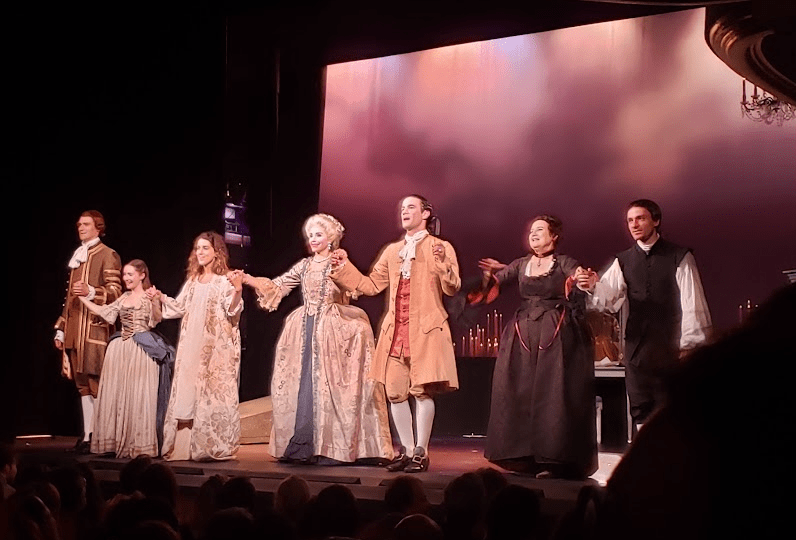
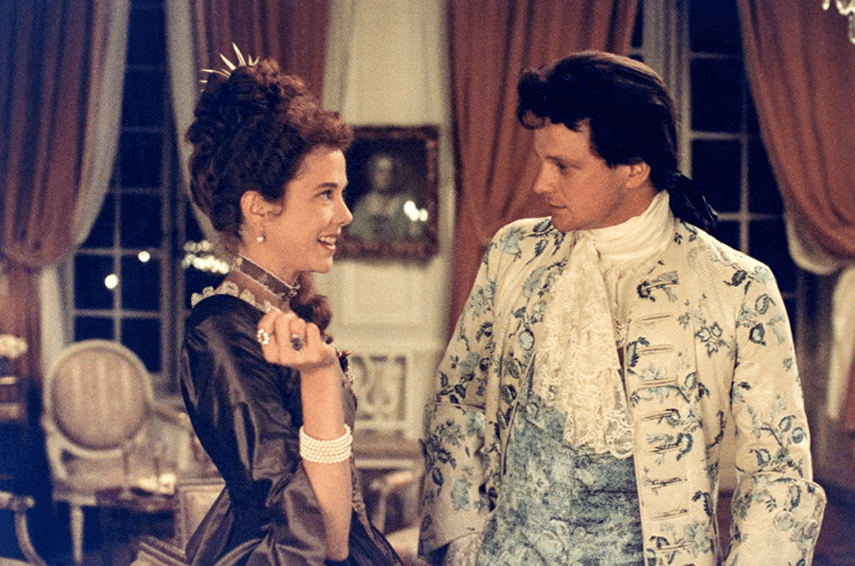
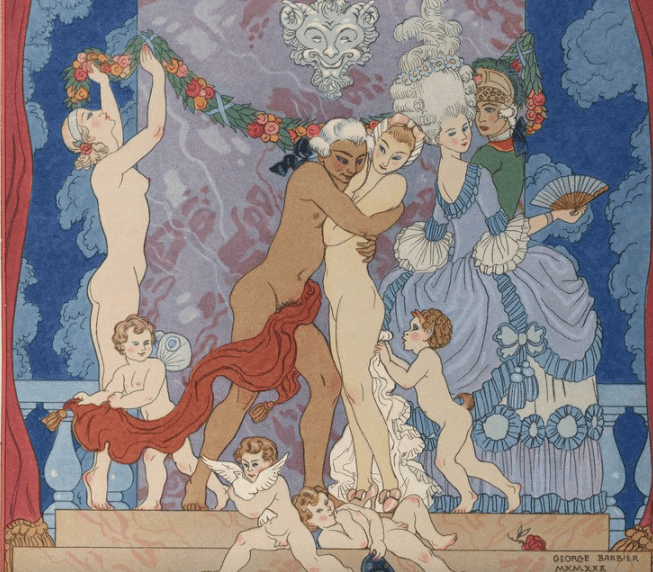



 Reading Liaisons