
Choderlos de Laclos’ novel is extraordinarily rich in ambiguities and unanswered questions.
Its real mysteries, of course, are those of the heart; since the two main letter-writers, Valmont and Merteuil, constantly lie to others and arguably to themselves, what they are actually thinking and feeling often remains a conjecture. (Valmont is usually honest with Mme de Merteuil, but that too eventually changes as the two protagonists turn against each other.) The question of whether Valmont “really” falls in love with Mme de Tourvel or sees her only as his libertine “project” to the very end has been endlessly debated by Laclos scholars; there has also been considerable debate on what Merteuil really feels toward Valmont and he toward her. More on that later.
But the novel also leaves many “gaps” when it comes to factual issues. We know virtually nothing about Valmont and Merteuil’s past relationship, other than that they became involved after their respective lovers at the time, the Comte de Gercourt and the nameless “Intendante”-wife of a chief administrative official in a province-ditched them for each other. (Merteuil’s vengeance against Gercourt drives the plot to corrupt Cécile de Volanges, who is set to marry him.) We know they were lovers for a period of time and then made a mutual decision to part ways forever, an agreement “sealed” by a final lovemaking on a couch in Merteuil’s suburban pleasure house. But how long ago was this? (A footnote to Letter 2 says only that “this adventure considerably precedes the events which these letters concern.”) How long were they together? Why did they break up? All we get is tantalizing tidbits. (For instance, in her autobiographical letter, Letter 81, Merteuil points out that if Valmont had wanted to make their initial affair public, he would have found it hard to damage her reputation, since he would have had nothing to tell but “a sequence of improbable facts of which the true account would sound like a bad novel.”)
There’s a lot more we don’t know, starting with the first names of the principal characters except for Cécile de Volanges. The two protagonists’ ages are also unknown-which is interesting considering that we do know the ages of most of the other major characters: Mme de Tourvel (22), Cécile (15), Danceny (20), and Mme de Rosemonde (84). It’s doubly interesting considering that Valmont actually mentions his age at one point, but doesn’t specify what it is, only that he’s old enough to be a mature man (Letter 125: “Am I, at my age, going to be mastered like a schoolboy by an unknown and involuntary feeling?”); meanwhile, his complaint of a “premature old age” in Letter 6 suggests that he’s probably not much over 30. As for Merteuil, I recently came across a 1996 essay arguing that she is actually nearing menopause and that awareness of losing her looks accounts for her intense jealousy of Tourvel; but that’s a thesis that sounds like something hatched on a “red pill” forum and that requires a highly creative reading of the material. In fact, Merteuil describes herself as a “young woman” in the letter to Volanges giving the “official” version of the Prévan incident: “My God, how unhappy a young woman’s lot is! She has achieved nothing when she has placed herself beyond the reach of gossip; she must safeguard herself against slander, too.” (Letter 87)
However, there are two major “ambiguities of fact” that, to my knowledge, have received little if any attention.
- What is Valmont’s past really like, and is Mme de Volanges’ scathing assessment of his record to be taken completely at face value?
- Is it an absolute fact that Mme de Merteuil is horribly disfigured at the end of the novel?
On Point 1, our knowledge of Valmont’s reputation comes primarily from Mme de Volanges, who does not mince words in her first letter to Mme de Tourvel:
Even more deceitful and dangerous than he is charming and seductive, he has never, from his earliest youth, taken a step or spoken a word without having some kind of design, and has never had a design that was not nefarious or criminal. … He’s learned to calculate exactly what atrocities a man can commit without compromising himself; and, to be cruel and vicious without risk, he has chosen women for his victims. I’m not even pausing to count how many he has seduced; but how many has he not ruined?
Leading a modest and secluded life as you do, these scandalous stories do not reach your ears. I could tell you some that would make you shudder… The only thing I will tell you is that, of all the women he has pursued, successfully or not, there is not one who has not had cause to complain of him.
Letter 9
Of course, Valmont’s subsequent conduct does not exactly prove Mme de Volanges wrong; what’s more, Valmont himself repeatedly mentions “ruining” women, and Merteuil credits him with having “seduced, even ruined many women.” But interestingly, Laclos never gives us any glimpse of Valmont’s past villainies; there are several references to his past liaisons, but they all sound like fairly run-of-the-mill affairs with consenting adults. The only “flashback” episode we get in which three women are thoroughly destroyed by a humiliating scandal, to the point of being “banished” from society-one joins a convent, two retreat to their estates-involves Valmont rival and “double” Prévan as the hero/villain.
“Ruined,” in the context of 18th Century French upper-class society which, double standard notwithstanding, was generally quite tolerant of female sexual foibles, could mean a wide range of things. It could mean that you were a social pariah for life, or that your husband or parents locked you up in a convent. (An affair with a fellow upper-class male like Valmont was unlikely to have such dire consequences; the Comtesse de Stainville, who got locked up by her husband in 1767, had emerged unscathed from adulterous affairs with several noblemen including her own brother-in-law, but made a fatal misstep when she began to flaunt an affair with an actor.) It could mean that you were compromised by a scandal but it would blow over in a few months, so all you had to do was wait it out on your estate in the country. It could mean that people gossiped about you behind your back and your reputation was stained but not shot to pieces.
Merteuil mentions (Letter 81) that Valmont owes his “celebrity” to “the art of creating a scandal, or seizing the opportunity for one”; most of the women involved in these scandals undoubtedly suffer some reputational damage. Nonetheless, a number of passages in Liaisons make it quite clear that Valmont’s past conquests remain very much a part of respectable society. We also know of at least two former mistresses with whom Valmont seems to be on perfectly good terms and who seem more than willing to have him back for repeat engagements: the Vicomtesse de M. in Letter 71 and the Comtesse de B. in Letter 59 (“I have received a pressing invitation from the Comtesse de B. to visit her in the country; as she rather amusingly puts it, ‘her husband has the finest park in the world, which he keeps carefully tended for the enjoyment of his friends.’ Now, as you know, I have certain claims to that park, and I’ll go pay it a visit if I can’t be of any use to you”).
In his 1969 study The Novel of Worldliness, Peter Brooks even suggests that Valmont’s account to Tourvel of his libertine beginnings-being “passed around among a crowd of women” as a young and inexperienced man (Letter 52)-may, however self-serving, be not too far from the truth; it is, at least, similar to the narrative of such “worldly” novels as Crébillon’s Errors of the Heart and Mind.
Obviously, none of this exonerates Valmont or makes him an unjustly maligned fun-loving guy: His actions in the novel show him to be quite capable of “atrocities.” It just means that the reality in Liaisons is always more multilayered than it seems at first glance.
And now on to Point 2, which is a much bigger deal.
Merteuil’s “punishment” has always been somewhat controversial because it seems so over the top. She’s socially disgraced by the exposure of her letters, she loses her fortune to a lawsuit, and she loses her looks (and an eye!) to smallpox! (And then the “publisher’s note” at the end-apparently not written by Laclos-refers to “sinister events which compounded the misfortunes, or completed the punishment, of Mme de Merteuil”; really, what else? a house flies in from Kansas and drops on her head?) Many have found the ending unconvincing and weak. According to University of Leeds scholar David Coward:
The ruin and disfigurement of Madame de Merteuil, a shameless return to the “vice puni” [vice punished] tradition, is engineered by that mysterious, transcendental agency which, up to this point, has been carefully excluded from the novel. The dénouement of Les Liaisons Dangereuses is therefore not only an aesthetic mistake. It is a change of mood, of viewpoint, which returns us to the cosmic and obscures the meaning of the drama.
Coward, D. A. (1972). Laclos and the Denouement of the Liaisons Dangereuses. Eighteenth-Century Studies, 5(3), 431–449.
Coward (who, it should be noted, takes a much more nuanced view of the ending in his introduction to the 1998 Oxford University Press edition of Liaisons) argues that while the two libertines’ downfall makes sense, it should have been an outcome of their self-destructive flaws: vanity, overconfidence in their superiority, and denial of the power of their own emotions. I think Valmont’s trajectory fits that pattern completely. (Coward’s 1972 essay both underestimates the extent of Valmont’s sentimentalism before the last twenty pages of the novel and overestimates the extent to which he is “reformed” at the end.) Merteuil’s social disgrace is also a logical outcome of her war with Valmont, and the loss of her lawsuit (which has been mentioned throughout the novel) is a logical outcome of her disgrace. The ancien régime was not very big on judicial impartiality. The judges would have been most certainly aware of the fact that the litigant in the case was no longer an illustrious and respectable lady but a social outcast in the midst of a major and devastating scandal, and it would have certainly affected their decision.
However, the illness and resulting disfigurement is indeed very deus ex machina.
Christopher Hampton, who scrubbed Merteuil’s downfall from his play altogether, said in a 2015 interview that he thought Laclos was “winking” at the reader and making the punishment deliberately over the top to convey that he was only doing this in deference to convention, which required him to “impose a moral ending.” (For what it’s worth, Coward strongly disagrees and thinks that Laclos was expressing his own vision.)
But there’s another possibility, which is that Laclos deliberately leaves some ambiguity as to whether the disfigurement is real.
What do we really know? At this point, our narrator is (again!) Mme de Volanges, writing to Mme de Rosemonde, and if there’s one thing we know about Volanges is that she’s chronically and hopelessly clueless. She’s completely blind to Cécile’s romance with Danceny until Merteuil tips her off. She warns Tourvel about Valmont (with melodramatic flourishes that may paradoxically lessen the effect of her warnings), but is completely oblivious to Tourvel falling for Valmont, day by day, right under her nose when they are all staying at Mme de Rosemonde’s château. (Their hostess is much more perceptive; when Tourvel flees back to Paris and leaves behind a letter saying she is desperately in love, Rosemonde replies: “Long experience -and my interest in you-were enough to make clear to me the state of your feelings; and, to tell you the truth, there was nothing, or almost nothing, in your letter that was new to me.” [Letter 103]) When Cécile looks frighteningly haggard at breakfast and bursts into tears the morning after her not-very-consensual defloration by Valmont, her mother thinks she’s just pining for Danceny. Her cluelessness persists to the end: after Cécile runs away to a convent following Valmont’s death at Danceny’s hand and the exposure of Merteuil’s duplicity, Volanges’ worst conjecture is that she secretly lost her virginity to Danceny.
So, basically, every piece of second-hand information that comes to us solely from Volanges needs to be taken with a big chunk of salt.
In her next-to-last letter, December 18 (Letter 173), Volanges describes Merteuil’s public humiliation at the Italian Theater, where she arrives after a short stay in the country unaware that her letters have been circulating; no one visits her in her box, and during the intermission, when she sits down on a bench in the salon, all the women already sitting there get up and walk away (to a big round of applause from the men). Then, Prévan makes a triumphant entrance. This scene is described to Volanges by an eyewitness, so we can assume it’s mostly true (and it would be common knowledge anyway, since it happens in public). Then, we’re told that the next evening Merteuil came down with a high fever which was initially attributed to nervous shock, but then turned out to be a really bad case of smallpox.
Volanges’ next letter to Rosemonde (January 14), which is also the final letter in the book, opens thusly:
Mme de Merteuil’s fate finally seems to be resolved, my dear and worthy friend, and it is such that even her worst enemies feel divided between the indignation she merits and the pity she inspires. I was quite right to say that perhaps it would have been a blessing for her to die of that smallpox. She has recovered, it’s true, but horribly disfigured; in particular, she has lost an eye. As you may judge, I haven’t seen her again, but I’ve been told she is truly hideous.
The marquis de ***, who never misses an opportunity to say something nasty, remarked yesterday, in speaking of her, that the illness turned her inside out and she now wears her soul on her face. Unfortunately, everyone thought it was very accurate.
Letter 175
Then we learn that Merteuil also lost her pending legal case, her entire fortune is going to the plaintiffs (children related to her late husband) with the remainder consumed by court costs, and she has fled in the dead of night, taking all of her silver and jewelry (including priceless family diamonds) and leaving behind 50,000 livres of debts. “It is believed that she travelled toward Holland,” writes Volanges.
Note that Volanges stresses she hasn’t seen Merteuil in her new hideous condition; nor does she even mention a specific person who has seen her (in contrast to the “man of my acquaintance” who reports on her humiliation at the theater). Has anyone seen her? Even if Merteuil has appeared in public (which is doubtful), it would have been under a veil.
Laclos has an extraordinary attention to detail (see the previous post for his attention to consistency of dates and days of the week). So I seriously doubt it’s an accident that he practically stresses that Volanges has no firsthand or even secondhand knowledge of Merteuil’s disfigurement.
It is notable that two 21st Century books based on Les Liaisons Dangereuses-the 2000 novel Le mauvais genre (“The Bad Kind”) by Belgian writer Laurent Graeve, a Merteuil “memoir” that begins with Valmont’s death, and A Factory of Cunning, Philippa Stockley’s 2005 quasi-sequel-both treat the smallpox as a cover story Merteuil has spread with the help of her loyal maid Victoire, both as a distraction from her disgrace and as a way to facilitate her flight from Paris.
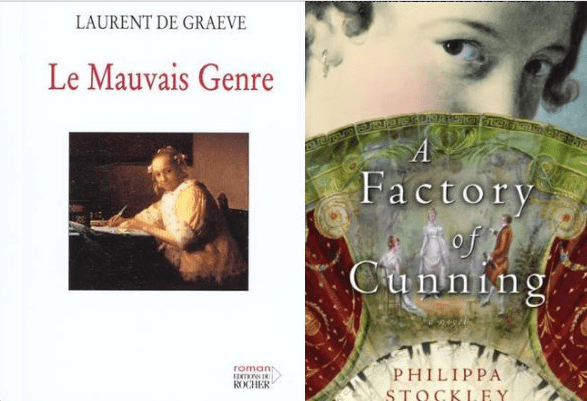
It should be noted that both novels take a lot of liberties with the source material: Le mauvais genre is a reworking that changes many events and makes the story a lot nastier than it already is (among other things, Cécile becomes Valmont’s illegitimate daughter from an old affair with Mme de Volanges), while A Factory of Cunning does not explicitly identify its lead character, a French noblewoman on the run from a scandal in 1784, as Merteuil. But is the faked smallpox so improbable? Merteuil’s flight is undoubtedly prepared in advance: in Letter 134, we see that Merteuil was already worried about the outcome of her case nearly a month before her exposure, and after it she had to know her chances of winning in court were almost nil. Faking smallpox to cover her tracks would be a very Merteuil move; her servants could be easily paid off to collude, and the same goes for the doctors. (Earlier, we saw Valmont arrange for two doctors to cover up Cécile’s miscarriage.)
Did Laclos have such a possibility in mind? I will just reiterate that, at the very least, there is probably a reason he left a certain amount of reasonable doubt as to Merteuil’s fate. There may even be a certain symbolism in the fact that the news of Merteuil’s loss of an eye comes to us via the chronically “blind” Volanges.
If Merteuil doesn’t necessarily get disfigured, that puts the novel’s ending in a different light in a number of ways, including “who really wins the battle of the sexes.” (More on that later.) Yet, oddly, it’s a scenario that doesn’t seem to have been explored much if at all by Laclos scholars.
 Reading Liaisons